
CURRENT AFFAIRS | 7 MAY 2026
CLAT GK + INTERNATIONAL RELATIONS & TREATIES
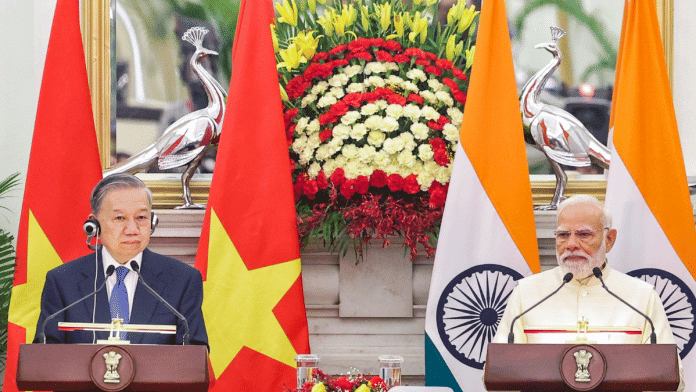
India’s foreign policy architecture in the Indo-Pacific region took a significant step forward on May 6, 2026, when Prime Minister Narendra Modi and Vietnam’s President and Communist Party General Secretary To Lam elevated bilateral ties to an Enhanced Comprehensive Strategic Partnership (ECSP). This upgrade from the 2016 Comprehensive Strategic Partnership marks the 10th anniversary of that foundational pact and signals deepening strategic alignment on issues ranging from the South China Sea to rare earth supply chains.
The meeting produced 13 Memoranda of Understanding (MoUs) spanning digital technology, pharmaceutical regulation, cultural exchange 2026-2030, space cooperation (ISRO–Vietnam National Space Centre), renewable energy, atomic energy, and crucially, rare earth minerals — a sector where Vietnam holds the world’s second-largest reserves after China. India’s growing semiconductor manufacturing ambitions make access to rare earths a strategic necessity.
On the defence front, the two leaders reaffirmed defence as a “key pillar” of the relationship, with Vietnam reportedly in advanced discussions for procurement of the BrahMos supersonic cruise missile — a deal valued at approximately Rs 5,800 crore. BrahMos, the world’s fastest supersonic cruise missile, is co-produced by India’s DRDO and Russia’s NPO Mashinostroyeniya, named after the Brahmaputra and Moskva rivers. In the South China Sea, the joint statement stressed adherence to UNCLOS (UN Convention on the Law of the Sea) and “freedom of navigation and overflight” — coded language that signals shared concern about Chinese expansionism without naming Beijing directly.
- UNCLOS (1982, in force 1994): Art. 3 — 12nm territorial sea; Art. 33 — 24nm contiguous zone; Art. 55–75 — 200nm EEZ
- DOC (Declaration on Conduct of Parties, 2002): Non-binding ASEAN-China agreement on South China Sea conduct
- ASEAN: 10-member bloc — India’s Act East Policy prioritises this grouping; HQ Jakarta, Indonesia
- India’s Act East Policy (2014): Replaced Look East Policy (1992, PV Narasimha Rao) — more proactive approach to ASEAN + Pacific
- IPOI (Indo-Pacific Oceans Initiative, 2019): Launched at East Asia Summit, Bangkok; 7 pillars including maritime security
- India-Vietnam CSP (2016): Upgraded to Enhanced Comprehensive Strategic Partnership on May 6, 2026
- BrahMos: India-Russia co-production; world’s fastest supersonic cruise missile; named Brahmaputra + Moskva
CLAT GK passages on India-ASEAN relations frequently test: (a) the difference between UNCLOS zones (territorial sea = 12nm, contiguous = 24nm, EEZ = 200nm), (b) the hierarchy of India’s bilateral relationships (CSP vs. ECSP vs. Strategic Partnership — knowing which country holds which tier), and (c) the look-act-east policy evolution and its initiators.
A typical trap: “Look East Policy was launched by PM Vajpayee.” WRONG — it was initiated by PV Narasimha Rao in 1992, then carried forward through Vajpayee and Manmohan Singh governments, before being upgraded to Act East by Modi in 2014.
On UNCLOS, CLAT passages frequently ask about the South China Sea dispute. Key point: China claims a “Nine-Dash Line” covering most of the South China Sea, which an Arbitral Tribunal (2016, Philippines vs. China) held was inconsistent with UNCLOS. China rejected that ruling. Vietnam, like India, supports UNCLOS compliance — making this partnership strategically coherent.
| Date of ECSP Elevation | May 6, 2026 — New Delhi |
| Vietnam President | To Lam (also Communist Party General Secretary) |
| Previous Partnership Level | Comprehensive Strategic Partnership (CSP, 2016) |
| MoUs Signed | 13 — digital tech, pharma, space (ISRO), rare earths, energy, culture |
| Trade Target by 2030 | USD 25 billion (current ~USD 15 billion) |
| BrahMos Deal (Discussed) | ~Rs 5,800 crore; India-Russia co-produced supersonic missile |
| Act East Policy Launched | 2014 by PM Modi (replaced Look East Policy of 1992) |
| UNCLOS EEZ Limit | 200 nautical miles from baseline |
| ASEAN Members | 10 members; Secretariat in Jakarta, Indonesia |
MNEMONIC: “BRAVE” — BrahMos, Rare Earths, ASEAN, Vietnam, ECSP
B = BrahMos missile deal — India-Russia weapon for Vietnam defence
R = Rare earth minerals MoU — critical for India’s semiconductor future
A = Act East Policy (2014) — framework within which ECSP sits
V = Vietnam = ASEAN member 10, South China Sea stakeholder
E = ECSP (2026) upgraded from CSP (2016) — 10-year anniversary
Memory hook: “India and Vietnam are BRAVE partners in the Indo-Pacific — both believe China’s claims in the South China Sea must be tested against UNCLOS.”
Practice Quiz — 10 CLAT-Style Questions
Click an option to reveal the answer and explanation.