
CURRENT AFFAIRS | 27 APRIL 2026
DISASTER LAW & ENVIRONMENT | ARTICLE 21 RIGHT TO HEALTH
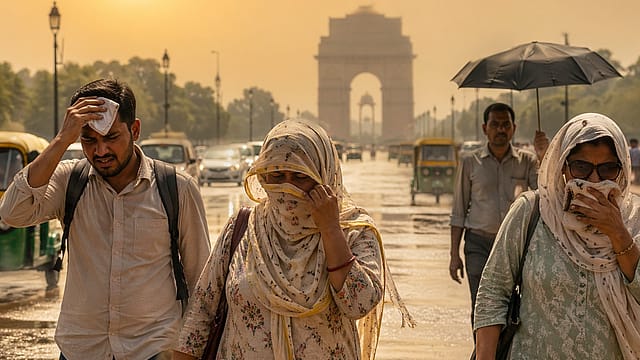
Delhi Chief Minister Rekha Gupta on 26 April 2026 unveiled the city’s Heatwave Action Plan 2026 as the capital crossed 42°C — 3.1°C above the long-term seasonal average. The plan operationalises NDMA’s 2024 heat-action SOPs at the city level: scientific thermal mapping of hotspots, ORS distribution to school children, dedicated “cool rooms” at 30+ hospitals (5 beds each, 339 health centres on alert), misting systems at bus stops, anti-smog guns at construction sites, and a 28,674 sqft reflective coating at Kashmere Gate ISBT.
Construction work between 12pm and 3pm is to be banned during severe-heatwave days. The bigger constitutional pivot: under the Disaster Management Act, 2005, NDMA has notified heatwave as a state-specific disaster, opening up SDRF funds and triggering Article 21 jurisprudence on the right to a livable climate.
Constitutional & Legal Framework
- Article 21 — right to life expanded to include the right to health and a clean environment (Subhash Kumar v State of Bihar, 1991)
- Article 47 DPSP — duty of the State to raise nutrition and improve public health
- Article 48A — protection and improvement of environment
- Disaster Management Act, 2005 — Section 12: SDRF funding for state-notified disasters including heatwave
- NDMA Heatwave Guidelines (2019, updated 2024) — Tmax >= 40°C threshold in plains
- India Cooling Action Plan (ICAP), 2019 — 25-40% cooling demand reduction by 2037-38
- Kigali Amendment, 2016 — phase-down of HFC refrigerants under Montreal Protocol (India ratified 2021)
- MK Ranjitsinh v UoI (2024) — SC recognised the right to be free from adverse impacts of climate change under Article 21
Why This Matters for CLAT 2027
Heat governance now sits at the intersection of environmental constitutionalism, disaster law and public health — three CLAT favourites:
- Right to clean environment under Article 21 — passage-based Legal Reasoning
- NDMA-SDMA architecture under DM Act, 2005 — factual GK + governance question
- India’s climate commitments — Paris/UNFCCC/Kigali — international relations
- Public health DPSP (Article 47) — rare but examinable in 2026 cycle given the Ranjitsinh ruling
Key Facts at a Glance
| Item | Detail |
|---|---|
| Delhi temp on launch day | 42°C (3.1°C above seasonal average) |
| Cool rooms operationalised | 30+ hospitals (5 beds each) |
| Health centres on alert | 339 across all 11 districts |
| Reflective coating area | 28,674 sqft at Kashmere Gate ISBT |
| Construction ban window | 12pm-3pm during severe heatwave |
| NDMA heatwave threshold (plains) | Tmax >= 40°C with departure >= 4.5°C |
Mnemonic — “COOL DELHI”
Cool rooms (30+ hospitals) · ORS for school kids · Outdoor work ban (12-3pm) · Low-emission misting at bus stops · Disaster Management Act notification · Environment Article 48A · Life Article 21 (Ranjitsinh 2024) · Health Article 47 DPSP · ICAP 25-40% cut by 2037.
Implications & The Road Ahead
Delhi joins Ahmedabad (the original 2013 HAP city) and now 23+ cities with formal heat-action plans. The next constitutional question — already pending in PILs before the Delhi HC — is whether outdoor labour rights during severe heat can be enforced as part of Article 21 read with Article 23 (right against forced labour). The 2024 Ranjitsinh judgment provides the template. Watch the NDMA Climate Risk Index due later in 2026 for fund-flow re-prioritisation.
Test Your Understanding — 10 CLAT-Style MCQs
Apply the constitutional anchors and current-affairs facts above. Each question has a detailed explanation.
Practice Quiz — 10 CLAT-Style Questions
Click an option to reveal the answer and explanation.