
CURRENT AFFAIRS | MAY 8, 2026
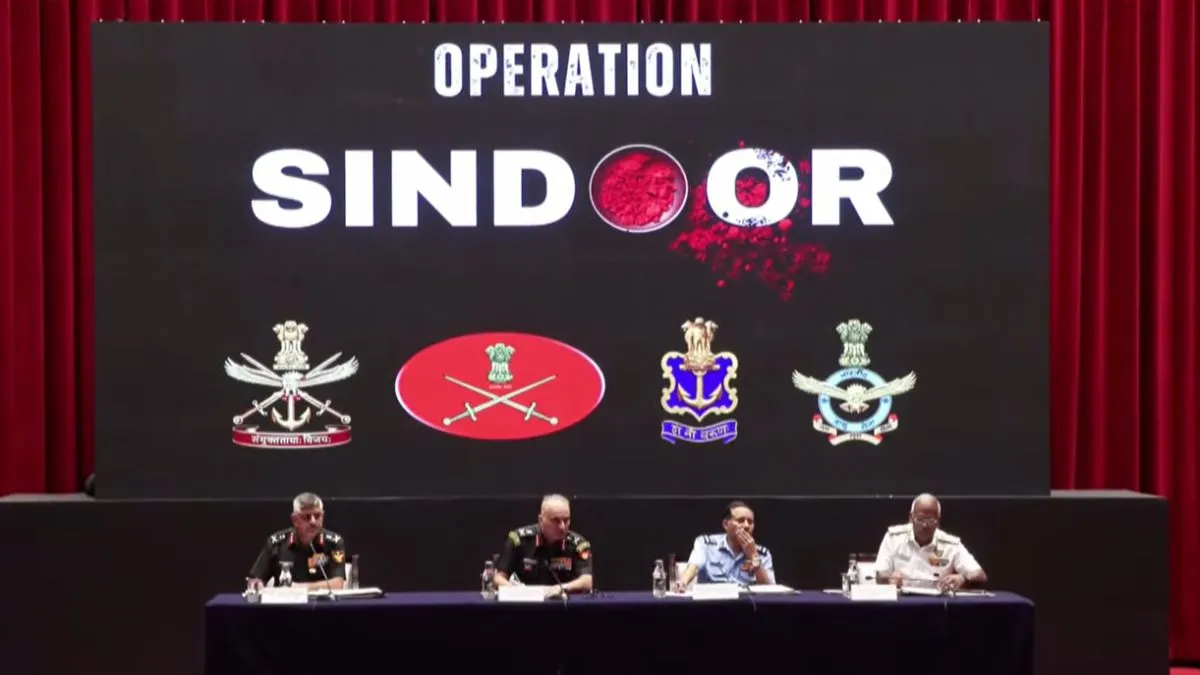
On May 7, 2025, India did something it had never done before at such scale: it launched precision strikes against 9 terrorist infrastructure targets deep inside Pakistan and Pakistan-occupied Kashmir, striking as far as 300 km into Pakistani territory. One year later, on May 7, 2026, Indian armed forces addressed a press conference in Jaipur to mark the anniversary — and to send an unambiguous message. Operation Sindoor, said Air Marshal Awadhesh Kumar Bharti, “has not ended — it has only been paused.” Three new strategic doctrines now define India’s security posture. And the legal framework — both domestic and international — that surrounds this operation is a CLAT examiner’s dream.
Constitutional and International Legal Framework
Art. 246 + List I Entry 1 (Defence): Parliament has exclusive power to legislate on defence of India and every part of it. The Armed Forces and their deployment are under Union jurisdiction — state governments have no role.
Art. 352 (National Emergency): Operation Sindoor was conducted without declaring a national emergency — demonstrating that the Union executive (under Art. 53 and the Defence Ministry) has operational authority for limited military action without a formal emergency declaration.
UN Charter Art. 51 (Self-Defence): India’s legal basis for the strikes was Art. 51 — the inherent right of self-defence against an armed attack. The Pahalgam attack (26 civilians killed, April 22, 2025) was attributed to Pakistan-based groups. India argued this was an “armed attack” triggering Art. 51.
UN Charter Art. 2(4) (prohibition on force): Pakistan argued India violated Art. 2(4) — which prohibits use of force against territorial integrity. India’s counter: Art. 51 self-defence overrides Art. 2(4). This Art. 51 vs Art. 2(4) tension is a classic international law debate for CLAT.
What Operation Sindoor Achieved — The Three New Normals
Military analysts and veterans have identified three strategic “new normals” that Operation Sindoor established:
- India will respond kinetically to terrorist attacks: The long-standing ambiguity about whether India would strike across the border in response to terrorism — tested by Uri (2016, surgical strikes), Balakot (2019, air strikes) — has been resolved. India struck 9 targets, including the Jaish-e-Mohammed HQ at Bahawalpur and Lashkar-e-Taiba’s base at Muridke.
- Nuclear overhang will not deter conventional strikes: Pakistan’s implicit nuclear threat did not prevent India from conducting the deepest cross-border conventional strikes since 1971. This fundamentally shifts deterrence theory in South Asia.
- Ceasefire terms need not be pre-negotiated: India struck, achieved its objectives, and then accepted a ceasefire — without the prior diplomatic dance that has traditionally preceded such outcomes. This is a new negotiation posture.
CLAT Angle — Key Legal Concepts
State-sponsored terrorism and international law: International law distinguishes between a state’s direct use of force (clearly governed by the UN Charter) and state-sponsored non-state actor attacks (a grey zone). India’s position: if a state shelters, funds, and arms terrorist groups that attack another state, the victim state has Art. 51 self-defence rights against those groups even on the sponsoring state’s territory — the “unable or unwilling” doctrine.
UNSC 1267 Sanctions Committee: Following Operation Sindoor, the UNSC 1267 Sanctions Committee designated The Resistance Front (TRF) — a shadow group linked to Lashkar-e-Taiba that claimed responsibility for Pahalgam — as a globally designated terrorist organisation. This is significant: a UNSC-level recognition of the group’s terrorist nature.
Indus Waters Treaty suspension: India suspended the Indus Waters Treaty 1960 (World Bank-brokered, governing water sharing of six rivers) after Sindoor — a major non-military diplomatic pressure lever.
UAPA domestic framework: Unlawful Activities (Prevention) Act 1967 is India’s primary domestic law for designating terrorist organisations and prosecuting terror offences. TRF’s UNSC designation complements its listing under UAPA domestically.
Military Transformation — One Year After
In the 12 months since Operation Sindoor, India has accelerated defence acquisitions worth Rs 30,000+ crore, including: loitering munitions (kamikaze drones), counter-drone systems, Scalex cruise missiles, BrahMos supersonic missiles (which played a decisive role in the operation), Hammer air-to-surface weapons, and S-400 Triumf air defence systems. The IAF struck at a record 300 km depth into Pakistan — enabled by standoff weapons that allow aircraft to fire without entering heavily defended Pakistani airspace.
Key Facts — Quick Reference
| Parameter | Detail |
|---|---|
| Operation Sindoor launch date | May 7, 2025 |
| Trigger: Pahalgam attack | April 22, 2025 — 26 civilians killed |
| Targets struck | 9 terrorist infrastructure sites in Pakistan and PoK |
| Maximum strike depth | 300 km inside Pakistan |
| Key weapons used | BrahMos, Akash, loitering munitions, standoff weapons |
| Treaty suspended by India | Indus Waters Treaty 1960 |
| UNSC designation post-Sindoor | TRF (The Resistance Front) — UNSC 1267 Committee |
| UN Charter self-defence article | Art. 51 |
| Defence acquisitions post-Sindoor | Rs 30,000+ crore in 12 months |
Mnemonic — SINDOOR to Remember
S — Self-defence: Art. 51 UN Charter is India’s legal basis
I — Indus Waters Treaty: suspended by India post-operation
N — Nine targets struck in Pakistan and PoK
D — Deterrence through kinetic action: the new doctrine
O — Operation paused (not ended): IAF Air Marshal Bharti
O — October TRF designation: UNSC 1267 sanctions
R — Rs 30,000+ crore acquisitions: BrahMos, loitering munitions, S-400
Practice Quiz — 10 CLAT-Style Questions
Click an option to reveal the answer and explanation.