
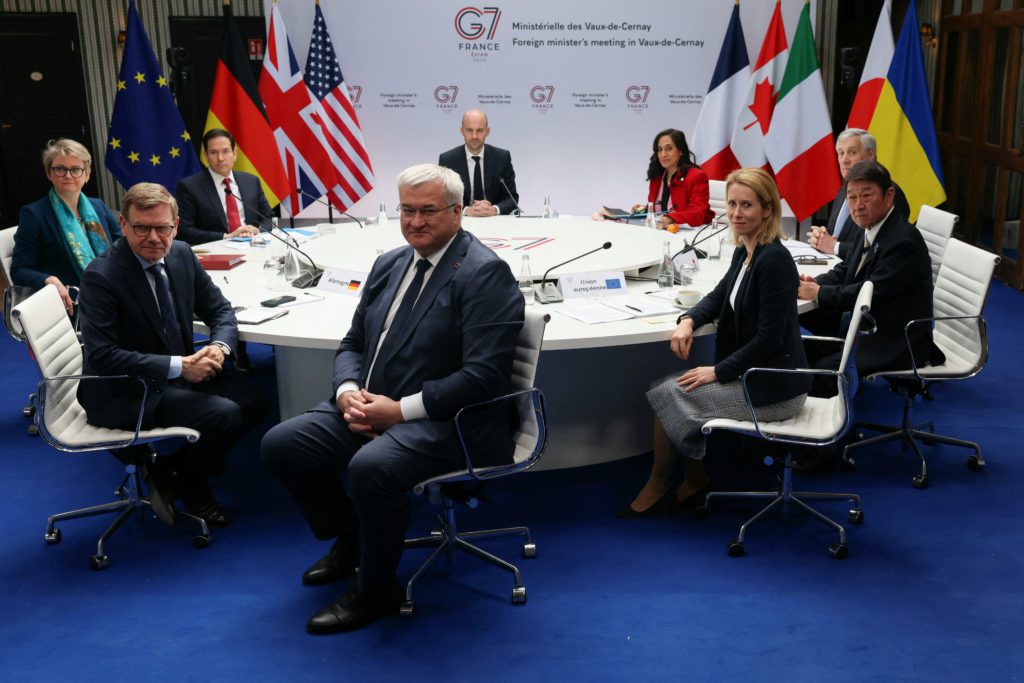
CURRENT AFFAIRS | MARCH 28, 2026
CLAT GK + INTERNATIONAL LAW (HUMANITARIAN LAW & ARMED CONFLICT)
The G7 foreign ministers, meeting at Abbaye des Vaux-de-Cernay in France on March 26-27, 2026, under the French G7 Presidency, issued a joint statement demanding an immediate cessation of attacks against civilians and civilian infrastructure in the ongoing Iran war. The statement declared that “there can be no justification for the deliberate targeting of civilians in situations of armed conflict as well as attacks on diplomatic facilities.”
The conflict, now in its fourth week since US-Israeli strikes on Iran began on February 28, has killed over 1,900 people and injured 2,000+, according to IFRC reports. The G7 also reiterated the need to restore safe and toll-free freedom of navigation in the Strait of Hormuz, through which approximately 40% of India’s crude oil imports pass. US Secretary of State Marco Rubio reportedly told allies the war could last “another 2 to 4 weeks,” while French Armed Forces Minister Catherine Vautrin stated that “the war is not ours” and emphasized a strictly defensive approach.
Why This Matters for CLAT
International Law Framework
- Geneva Conventions (1949): The four conventions form the core of International Humanitarian Law (IHL), protecting wounded soldiers, prisoners of war, and civilians. The G7 statement invokes these protections against deliberate targeting of civilian infrastructure.
- Principle of Distinction: IHL requires belligerents to distinguish between military targets and civilian objects at all times — a cornerstone principle being violated.
- Principle of Proportionality: Attacks must not cause civilian harm excessive relative to the concrete military advantage anticipated.
- Nicaragua v USA (ICJ, 1986): Established that customary international law prohibits the use of force against another state and intervention in its internal affairs.
- Nuclear Weapons Advisory Opinion (ICJ, 1996): The threat or use of nuclear weapons would generally be contrary to IHL.
- Responsibility to Protect (R2P): The international community’s duty to protect populations from genocide, war crimes, ethnic cleansing, and crimes against humanity.
CLAT Exam Angle
International law topics are increasingly tested in CLAT. Watch for:
- Passage-based reasoning: G7 joint statements as legal instruments, binding vs. non-binding nature of multilateral declarations
- IHL principles: Distinction, proportionality, necessity, humanity — applied to the Iran conflict scenario
- DPSP connection: Article 51 (promotion of international peace), India’s role in conflict resolution
- UN Charter: Chapter VII (Security Council powers), right to self-defense under Art 51 of the UN Charter, collective security mechanism
- Geopolitical reasoning: Strait of Hormuz significance, oil price impact on Indian economy, Western alliance divisions
Key Facts at a Glance
| Parameter | Details |
|---|---|
| G7 Meeting Venue | Abbaye des Vaux-de-Cernay, France |
| G7 Presidency | France (2026) |
| Meeting Dates | March 26-27, 2026 |
| Casualties in Iran | 1,900+ killed, 2,000+ injured |
| Conflict Start Date | February 28, 2026 |
| G7 Members | Canada, France, Germany, Italy, Japan, UK, USA + EU |
| Key Chokepoint | Strait of Hormuz (40% of India’s crude imports) |
| Core Legal Framework | Geneva Conventions 1949, IHL, R2P doctrine |
CLAT Mnemonic: GENEVA
G – G7 demands immediate ceasefire on civilian attacks
E – Established IHL principles: distinction, proportionality, necessity
N – Nicaragua v USA (1986): customary law prohibits use of force
E – Extreme measures: Nuclear Weapons Advisory Opinion (1996 ICJ)
V – Vaux-de-Cernay Abbey, France: venue of G7 meeting
A – Art 51 DPSP: India’s duty to promote international peace
Test Your Understanding
Practice Quiz — 10 CLAT-Style Questions
Click an option to reveal the answer and explanation.