

CURRENT AFFAIRS | MARCH 29, 2026
CLAT GK + INTERNATIONAL TRADE LAW & CONSTITUTIONAL LAW
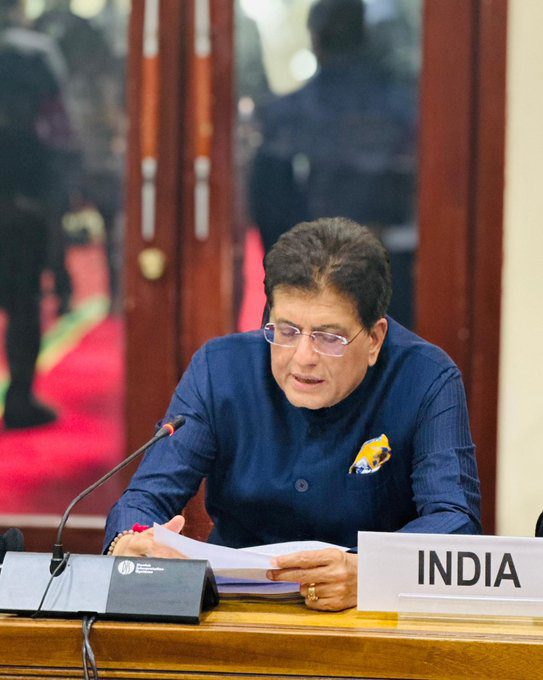
India on Saturday strongly opposed the contentious China-led Investment Facilitation for Development (IFD) Agreement and its incorporation into the WTO framework at the ongoing 14th WTO Ministerial Conference in Yaounde, Cameroon. Commerce and Industry Minister Piyush Goyal announced India’s position, stating that the plurilateral approach “risks eroding the foundational limits of the WTO and undermining its foundational principles.”
India stood as the sole dissenting voice against the IFD Agreement, which is backed by 128 of 166 WTO members. The agreement is proposed under Annex 4 of the Marrakesh Agreement, which contains Plurilateral Trade Agreements that are binding only on WTO members that have accepted them — unlike mandatory multilateral agreements.
What is the IFD Agreement?
The Investment Facilitation for Development (IFD) proposal aims to enhance the transparency of investment regulations to make countries more efficient and attractive to foreign and national investors. Originally backed by 70 countries in 2017, support has grown to 128 WTO members (~77%). Notably, around 98 of the supporting countries are also participants in China’s Belt and Road Initiative (BRI), indicating significant geopolitical overlap.
Why India Opposes It
- Multilateral integrity: Allowing plurilateral agreements to be incorporated without full consensus would undermine the WTO’s foundational principle of consensus-based decision-making
- Regulatory autonomy: India fears the IFD may indirectly constrain domestic regulatory autonomy in areas such as investment approvals and compliance standards
- Geopolitical concerns: India views IFD as a potential tool to amplify China’s economic and regulatory influence globally
- Precedent risk: Could transform the WTO into a fragmented institution where powerful blocs push through agreements without universal consent
Goyal invoked Mahatma Gandhi’s philosophy, stating: “Drawing inspiration from Mahatma Gandhi ji’s philosophy of Truth prevailing over conformity, India showed the courage to stand alone.”
Legal & Constitutional Framework
- Article 253: Empowers Parliament to make any law for implementing any treaty, agreement, or convention with any other country or any decision made at any international conference, association, or body.
- Article 246 read with Entry 83 (List I): Places “trade and commerce with foreign countries” in the Union List, giving Parliament exclusive legislative competence over international trade matters.
- WTO Marrakesh Agreement, Art. X: Governs amendments to WTO agreements and requires consensus for incorporation of new plurilateral agreements under Annex 4.
- GATT Principles: Most-Favoured-Nation (MFN) treatment and National Treatment — foundational non-discrimination principles that plurilateral agreements could potentially undermine.
- Plurilateral vs. Multilateral: Plurilateral agreements bind only accepting members; multilateral agreements bind all WTO members. India argues mixing the two erodes the WTO architecture.
CLAT Exam Angle
- GK Section: WTO structure and functions, India’s stand on multilateralism, China’s BRI and economic influence, Marrakesh Agreement
- Legal Reasoning: Passage-based questions on international trade law principles, plurilateral vs. multilateral distinction, India’s treaty-making power under Art. 253
- Current Affairs: India’s opposition at the 14th MC, Minister Piyush Goyal’s statement, consensus principle in WTO
- Logical Reasoning: Arguments for and against plurilateral agreements within multilateral frameworks
Key Facts at a Glance
| Agreement | Investment Facilitation for Development (IFD) |
| Led By | China |
| Supporters | 128 of 166 WTO members (~77%) |
| Proposed Under | Annex 4 of Marrakesh Agreement |
| India’s Position | Strongly opposed (sole dissenter) |
| WTO MC Venue | Yaounde, Cameroon (14th MC) |
| Indian Representative | Commerce Minister Piyush Goyal |
| Constitutional Provision | Art. 253 (treaty implementation) |
Mnemonic: PLURI
Remember India’s objections to the IFD with PLURI:
- P — Precedent risk (bypassing consensus)
- L — Legislative sovereignty at stake (Art. 253)
- U — Undermines WTO’s multilateral foundation
- R — Regulatory autonomy threatened
- I — Influence of China via BRI-linked bloc (98 BRI nations)
Conclusion
India’s firm stand against the IFD Agreement at the WTO reflects its consistent position on protecting multilateral frameworks from fragmentation through plurilateral backdoors. For CLAT aspirants, this event is a textbook case of international trade law intersecting with constitutional provisions on treaty-making (Art. 253) and legislative competence (Art. 246, Entry 83 List I). Understanding the difference between plurilateral and multilateral agreements within the WTO is essential for both GK and Legal Reasoning sections.
Practice Quiz — 10 CLAT-Style Questions
Click an option to reveal the answer and explanation.