
CURRENT AFFAIRS | 15 APRIL 2026
CLAT GK + INTERNATIONAL RELATIONS — ACT EAST, INDO-PACIFIC & CRITICAL TECH
What happened?
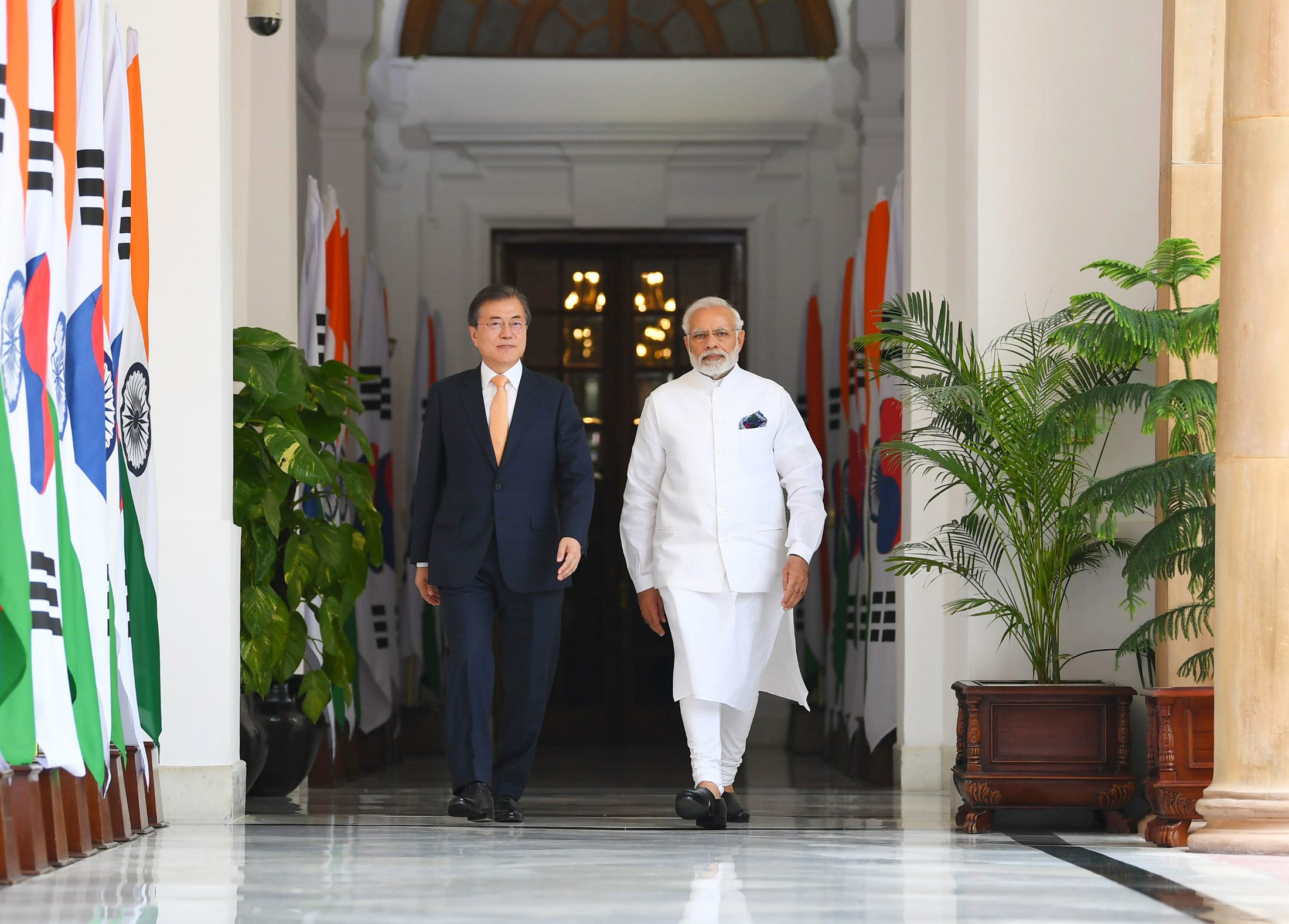
India and the Republic of Korea marked over 50 years of diplomatic relations (formalised in 1973) and a decade of the Special Strategic Partnership (2015). A Raja Mandala-style Ideas column in April 2026 argues that despite the milestones, there is a widening gulf between the two partners — in trade diversification, critical-technology cooperation and the Indo-Pacific balance — and that India must build a sturdier bridge. The immediate agenda: renegotiating the 2010 CEPA (India-Korea Comprehensive Economic Partnership Agreement), deepening semiconductor cooperation, expanding defence industrial ties, and using Korea as a pivotal node in India’s Act East and Indo-Pacific strategies.
Constitutional & Treaty Framework
- Article 51 (DPSP): Directs the State to promote international peace and security, foster respect for international law and treaty obligations, and encourage settlement of disputes by arbitration.
- Article 253: Empowers Parliament to make laws to implement any treaty, agreement or convention with foreign countries.
- Article 73 + Entry 10, Union List (Seventh Schedule): Foreign affairs, treaty-making and diplomatic relations are exclusively with the Union Executive.
- India-Korea CEPA (2010): First major FTA with a developed East-Asian economy; signed August 2009, in force from 1 January 2010; tariff concessions on 85% + goods.
- Special Strategic Partnership (2015): Elevated during PM Modi’s Seoul visit — covers defence, space, ICT, cultural exchange.
- India Semiconductor Mission (2021, MEITY): Framework for attracting chip-fabrication investment from partners including Korea.
CLAT Angle — Why This Matters
- Act East Policy: 2014 upgrade of the Look East Policy first launched by PM PV Narasimha Rao in 1991. Korea is one of India’s three northernmost “Act East” partners (with Japan and Mongolia).
- Indo-Pacific strategic construct: Integrates the Indian and Pacific Oceans as one theatre. Korea is a key Quad-Plus partner even though not a Quad member.
- Supply-chain resilience: Amid the US-China chip war, Korea (home to Samsung and SK Hynix) is a critical source of memory-chip and display technology for India’s electronics push.
- CEPA renegotiation: A live legal-economic story — Indian industry complains of asymmetric benefits. Expect passages on trade agreements, WTO GATT Article XXIV, and FTA rules of origin.
- Soft power: K-pop, Korean cinema and hallyu have deepened people-to-people ties — a cultural dimension of Article 51 cooperation.
Key Facts at a Glance
| Item | Detail |
|---|---|
| Diplomatic Relations | Established 1973 — 50+ years |
| Strategic Partnership | 2010 (elevated to Special Strategic Partnership in 2015) |
| CEPA | Signed August 2009, in force 1 Jan 2010 |
| Key DPSP | Article 51 — promotion of international peace |
| Treaty Implementation | Article 253 of the Constitution |
| Focus Sectors 2026 | Semiconductors, shipbuilding, defence, green hydrogen, AI |
| Quad Status | Korea is NOT a Quad member (Quad = India, USA, Japan, Australia) |
| Related Groupings | Quad-Plus, IPEF (Indo-Pacific Economic Framework) |
Mnemonic — “K-ACTS”
K-pop and cultural soft power · Act East Policy (Korea as northern anchor) · CEPA 2010 · Tech & semiconductors (Samsung, SK Hynix) · Special Strategic Partnership (2015). “K-ACTS” — remember this and the India-Korea question is done.
Illustrative CLAT Reading-Comprehension Angle
Expect a passage that contrasts India’s economic gains under CEPA with the rising trade deficit, then asks which constitutional provision empowers Parliament to pass enabling legislation for any renegotiated FTA (Article 253), which DPSP provides the policy aspiration (Article 51), and which list in the Seventh Schedule places “foreign affairs” under Union competence (Union List, Entry 10).
Test Yourself — 10 CLAT-Style MCQs
Practice Quiz — 10 CLAT-Style Questions
Click an option to reveal the answer and explanation.