
CURRENT AFFAIRS | MARCH 24, 2026
India’s 85% dependence on crude oil imports has been starkly exposed by the ongoing Strait of Hormuz crisis. With 20% of global oil transiting through Hormuz, any disruption directly hits India’s supply chain, pushing up LPG and fuel prices, straining household budgets, and feeding inflation. India must urgently accelerate its ethanol blending programme to reduce this dangerous dependence.
⚖️ Constitutional & Legal Framework
- Article 48A (DPSP) — Protect and improve the environment, safeguard forests and wildlife
- Article 51A(g) (Fundamental Duty) — Every citizen’s duty to protect the natural environment
- Article 21 — Right to life includes right to clean environment (read with Art 48A & 51A(g))
- Article 253 — Parliament can legislate to implement international agreements (Paris Agreement)
- M.C. Mehta v. UOI — Polluter pays principle and precautionary principle in environmental law
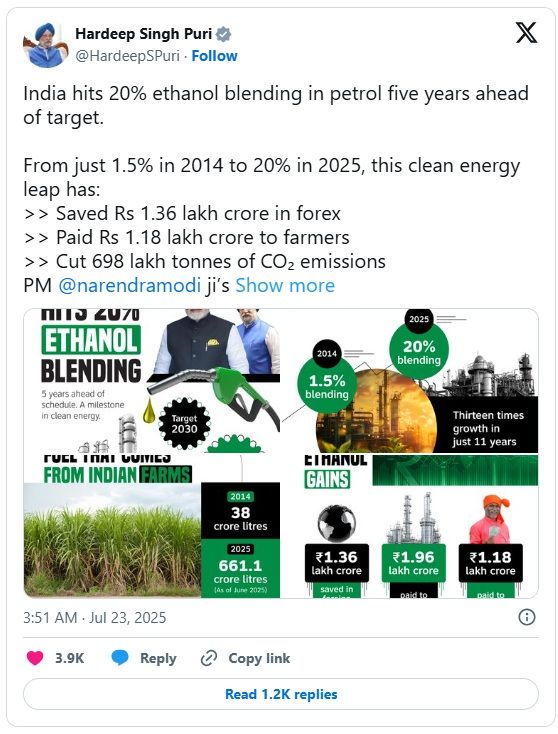
India’s E20 target — 20% ethanol blending in petrol by 2025-26 — draws inspiration from Brazil’s model (0% to 27% ethanol blending). Ethanol from sugarcane, rice, and maize can reduce oil imports while boosting rural farm incomes. The broader energy strategy includes EVs, solar, and wind power. India’s Paris Agreement commitment to reduce carbon intensity of GDP by 45% by 2030 provides the international policy framework.
🎯 CLAT Angle — Why This Matters
GK: Oil import dependence, ethanol targets, Paris Agreement. Legal Reasoning: Interaction between DPSPs, fundamental duties, and Art 21 environmental rights — apply M.C. Mehta principles. RC: Energy transition editorials. Art 253 (implementing international agreements) + climate treaties can distinguish top scorers.
📋 Key Facts at a Glance
| Oil dependence | India imports 85% of crude oil |
| Ethanol target | E20 — 20% blending in petrol by 2025-26 |
| Model country | Brazil — 0% to 27% ethanol blending |
| Paris commitment | Reduce carbon intensity of GDP by 45% by 2030 |
| Feedstock | Sugarcane, rice, maize → boosts rural incomes |
Key Terms and Definitions
| Term | Definition |
|---|---|
| E20 | Fuel blend of 20% ethanol + 80% petrol; India’s target by 2025-26 |
| Energy Security | Uninterrupted availability of energy at affordable prices — critical for import-dependent nations |
| Paris Agreement (2015) | COP21 treaty; India committed to reducing carbon intensity by 45% by 2030 from 2005 levels |
| Polluter Pays Principle | Those responsible for pollution bear cleanup costs — applied by SC in M.C. Mehta |
🧠 Mnemonic — “GREEN” for Energy Security
Green fuel (ethanol E20) • Reduce 85% oil dependence • Environment (Art 48A, 51A(g)) • Ethanol from sugarcane/rice/maize • Net zero via Paris commitments
Practice Quiz — 10 CLAT-Style Questions
Click an option to reveal the answer and explanation.
📰 Source: The Indian Express, 24 March 2026 • CLAT Gurukul Daily Current Affairs