
CURRENT AFFAIRS | 28 APRIL 2026
CLAT GK + ENVIRONMENTAL LAW & INTERNATIONAL ORGANISATIONS
India is finalising the ‘New Delhi Declaration’ for the Global Big Cat Summit, to be hosted in the national capital on 1 June 2026 — close on the heels of the 4th India-Africa Forum Summit (31 May). Heads of state from member countries will participate; Prime Minister Narendra Modi is expected to chair. The summit is the first major outing for the International Big Cat Alliance (IBCA), whose Secretariat is now operational in New Delhi under the Ministry of Environment, Forests and Climate Change with support from the MEA, reports the Indian Express (28 April 2026).
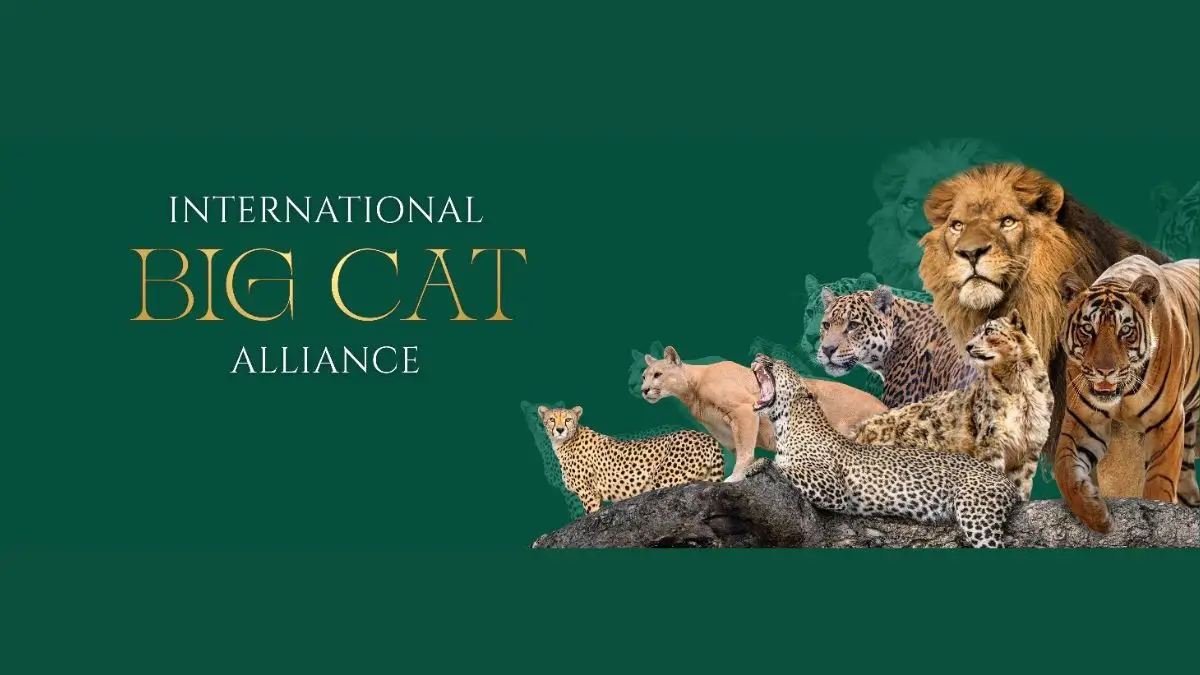
Modelled on the International Solar Alliance (ISA), the IBCA was launched by PM Modi on 9 April 2023 at Mysuru, commemorating 50 years of Project Tiger. The Cabinet approved its treaty-based status and Indian Headquarters on 29 February 2024. It currently has 24 member countries (10 from Africa); Kazakhstan, Namibia and Thailand are observers. The Alliance focuses on seven big cats: Tiger, Lion, Leopard, Snow Leopard, Cheetah, Puma and Jaguar — five of which are found in India.
⚖️ Constitutional & Legal Framework
- Article 48A (Part IV — DPSP) — duty of the State to protect and improve the environment and safeguard forests and wildlife (inserted by 42nd Amendment, 1976).
- Article 51A(g) (Part IVA — Fundamental Duties) — duty of every citizen to protect and improve the natural environment including wildlife and have compassion for living creatures.
- Article 21 — right to clean and healthy environment, read in by the Supreme Court since Subhash Kumar v State of Bihar (1991) and M.C. Mehta line of cases.
- Wildlife (Protection) Act, 1972 — Schedule I lists tiger, lion, leopard, snow leopard, cheetah; Schedule I species attract the highest penalties under §51.
- Project Tiger (1 April 1973) — flagship conservation programme; statutory backing via the National Tiger Conservation Authority (NTCA), 2005 — created by Wildlife (Protection) Amendment Act, 2006.
- CITES, 1973 — convention regulating cross-border trade in endangered species; India is a party since 1976. Tiger and snow leopard are Appendix I (no commercial trade).
- Convention on Biological Diversity (CBD), 1992 — domestic implementation via Biological Diversity Act, 2002.
- International Solar Alliance (ISA), 2015 — the institutional model: treaty-based, India-headquartered, open membership, focused on a single global public good.
📚 Why This Matters for CLAT 2027
Environment + International Organisations = a CLAT favourite combo. Expect a passage describing the IBCA Charter and asking (i) which Article of the Constitution provides the constitutional basis for India’s wildlife policy (Art 48A + 51A(g)), (ii) which Schedule of the Wildlife Protection Act lists the tiger (Schedule I), (iii) the difference between an MEA-led plurilateral alliance like IBCA and a UN treaty body. Cross-reference with the ISA template and the Coalition for Disaster Resilient Infrastructure (CDRI, 2019), both India-incubated. Likely Legal Reasoning angle: applying the public trust doctrine from M.C. Mehta v Kamal Nath (1997) to a hypothetical big-cat habitat case. Numbers worth memorising: India has 3,682 tigers (2022 census, latest), 891 Asiatic lions (Gir, 2025), and 20 cheetahs (Kuno-Palpur, post-translocation).
📊 Key Facts at a Glance
| Element | Detail |
|---|---|
| Summit | Global Big Cat Summit, New Delhi, 1 June 2026 |
| Declaration | ‘New Delhi Declaration’ (under finalisation) |
| IBCA launch | 9 April 2023, Mysuru, by PM Modi (50 years of Project Tiger) |
| Treaty status | Cabinet approval 29 Feb 2024; HQ in New Delhi |
| Members | 24 countries (10 African); Kazakhstan, Namibia, Thailand as observers |
| Species covered | 7 — Tiger, Lion, Leopard, Snow Leopard, Cheetah, Puma, Jaguar |
| Indian species | 5 of the 7 are found in India |
| Implementing ministries | MoEFCC (lead) + MEA (diplomatic) |
| Institutional model | International Solar Alliance (ISA), 2015 |
| Constitutional anchor | Articles 48A, 51A(g), 21; Wildlife Protection Act 1972 |
🧠 Memory Hook
‘TLLSCPJ’ — the seven IBCA species: Tiger, Lion, Leopard, Snow Leopard, Cheetah, Puma, Jaguar.
’48A + 51A(g) = Indian Eco-DNA’ — the DPSP-Duty pair on environment, both inserted by the 42nd Amendment, 1976. Read with Art 21 (Subhash Kumar) for the full Indian environmental constitution.
‘ISA→IBCA→CDRI’ — India’s three flagship plurilateral alliances: Solar (2015), Big Cats (2023), Disaster Resilient Infrastructure (2019).
The Conservation Diplomacy Play
The June Summit is more than a wildlife event: it is positioning India as the convener of a Global South-led conservation diplomacy bloc, paralleling its leadership of ISA on energy and CDRI on disaster resilience. The Declaration is expected to commit member states to One Health approaches, anti-poaching cooperation, ecosystem-finance mobilisation (possibly via the Green Climate Fund), and shared data platforms for trans-boundary big-cat monitoring. CLAT 2027 candidates should track three indicators: the final list of signatory countries, the formal text of the Declaration, and any specific monetary commitment from the Indian side — a likely follow-up to the ₹150 crore IBCA seed grant announced earlier. India’s tiger numbers (3,682 in 2022 vs. 1,411 in 2006) and Project Cheetah (Kuno) form the empirical backbone of the diplomatic pitch.
Practice Quiz — 10 CLAT-Style Questions
Click an option to reveal the answer and explanation.