

CURRENT AFFAIRS | 27 APRIL 2026
SCIENCE, TECHNOLOGY & NUCLEAR LAW | ATOMIC ENERGY ACT 1962
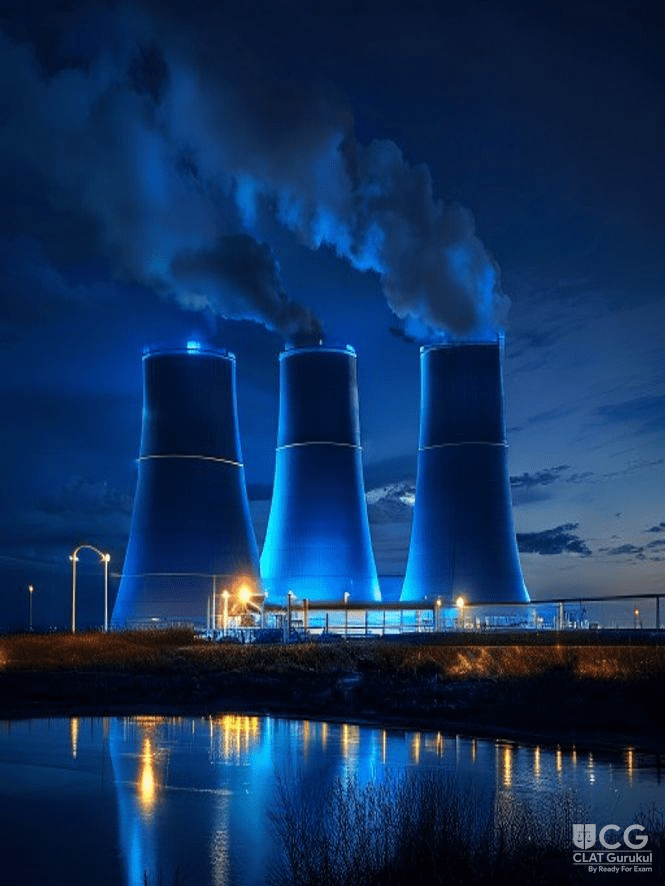
In his Mann Ki Baat broadcast on 26 April 2026, Prime Minister Narendra Modi hailed the Prototype Fast Breeder Reactor (PFBR-500) at Kalpakkam, Tamil Nadu, attaining criticality — its first self-sustaining nuclear chain reaction. The fully indigenous reactor marks India’s formal entry into Stage 2 of Dr Homi Bhabha’s three-stage civil nuclear programme, the doctrinal framework that has guided India since the 1950s: PHWRs (Stage 1, uranium) → Fast Breeders (Stage 2, plutonium) → Thorium reactors (Stage 3).
The PM also celebrated wind capacity crossing 56 GW, the return of blackbucks to Chhattisgarh, the Great Indian Bustard conservation push, and India’s win at the European Girls Mathematical Olympiad. For CLAT 2027 this is a clean GK + International Treaty + Article 51 DPSP cluster.
Constitutional & Legal Framework
- Atomic Energy Act, 1962 — vests exclusive control of atomic energy in the Union (Schedule VII, List I, Entry 6)
- Civil Liability for Nuclear Damage Act, 2010 — operator liability cap (Rs 1,500 crore); Section 17(b) supplier-recourse clause
- IAEA Additional Protocol — signed 2009, in force 2014
- India-US 123 Agreement (2008) — civil nuclear cooperation under US Atomic Energy Act 1954 + Hyde Act 2006
- NSG Waiver (Sept 2008) — India is NOT an NSG member but received a special exemption
- Article 51 DPSP — promote international peace, treaty obligations, dispute arbitration
- Wildlife Protection Act, 1972 — Schedule I covers Great Indian Bustard (highest protection)
- MK Ranjitsinh v UoI (2024) — right against adverse climate effects under Article 21 (cited in GIB case)
Why This Matters for CLAT 2027
- Three-stage nuclear doctrine appears regularly in CLAT factual GK and S&T sections
- India’s NPT-outsider status with NSG waiver is a perennial international-law passage
- CLND Act’s Section 17(b) is a contracts/tort question (supplier liability)
- Article 51 DPSP linkage to nuclear diplomacy is a high-yield short answer
- Mann Ki Baat clusters reward students who index multiple facts (wind 56 GW, GIB, EGMO) into a single answer
Key Facts at a Glance
| Item | Detail |
|---|---|
| Reactor | PFBR-500 (Prototype Fast Breeder, 500 MWe) |
| Location | Kalpakkam, Tamil Nadu |
| Operator / Builder | BHAVINI (DAE PSU) |
| Stage marker | Stage 2 of Bhabha’s 3-stage programme |
| Wind capacity | Crossed 56 GW (target: 500 GW non-fossil by 2030) |
| Other Mann Ki Baat highlights | Blackbucks Chhattisgarh, GIB conservation, EGMO win |
Mnemonic — “BHABHA-PFBR”
Bhabha’s 3-stage doctrine · HWR Stage 1 · Atomic Energy Act 1962 · BHAVINI builder · Hyde Act 2006 (US side) · Additional Protocol 2014. Then PFBR: Prototype · Fast · Breeder · Reactor — 500 MWe at Kalpakkam.
Implications & The Road Ahead
PFBR-500 criticality unlocks the path to commercial fast breeders and ultimately to thorium-based reactors — critical for India’s 500 GW non-fossil capacity target by 2030 under the updated Nationally Determined Contributions (NDCs). Watch for: (1) the Nuclear Energy Mission announced in Budget 2025-26 with Rs 20,000 crore outlay, (2) amendments to CLND Act Section 17(b) to enable foreign reactor deals (US-Westinghouse, French-Framatome), and (3) ongoing efforts for full NSG membership.
Test Your Understanding — 10 CLAT-Style MCQs
Apply the constitutional anchors and current-affairs facts above. Each question has a detailed explanation.
Practice Quiz — 10 CLAT-Style Questions
Click an option to reveal the answer and explanation.






