
CURRENT AFFAIRS | 22 April 2026
CLAT GK + CONSTITUTIONAL LAW (ARTICLE 19) & TECHNOLOGY
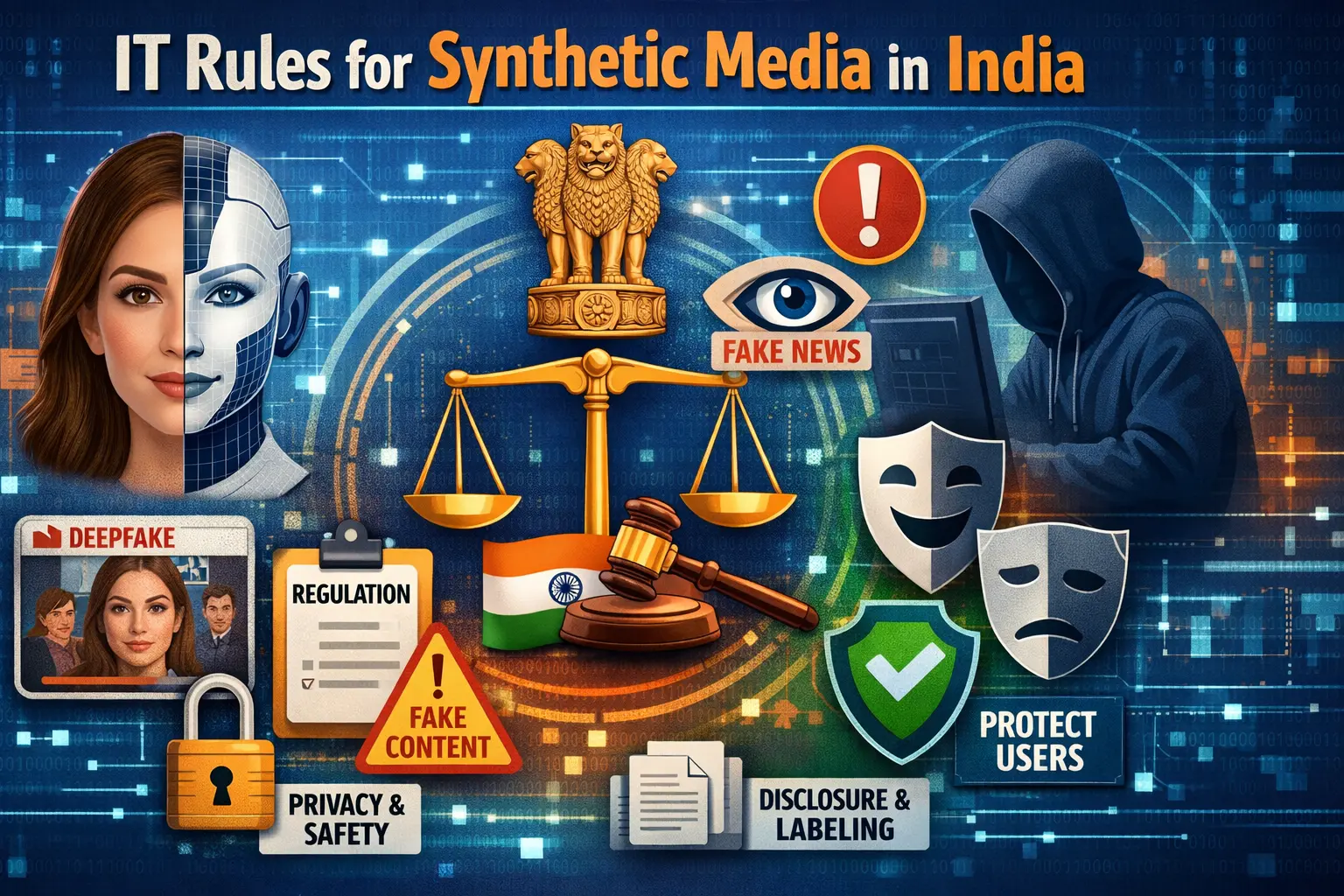
The Ministry of Electronics and Information Technology (MeitY) has notified amendments to the Information Technology (Intermediary Guidelines and Digital Media Ethics Code) Rules, 2021 — bringing Synthetically Generated Information (SGI) squarely within the intermediary-liability and due-diligence net. The October draft had prescribed that AI labels occupy at least 10% of a visual display or audio duration; the final notification replaces this with a qualitative “prominent, easily noticeable and adequately perceivable” test.
For CLAT 2027, this is a live controversy that sits at the intersection of Article 19(1)(a) free speech, Article 21 privacy/dignity, and statutory intermediary liability — a triple-barrel exam combination.
Statutory & Constitutional Framework
- IT Act, 2000 § 79 — “Safe harbour”: an intermediary is not liable for third-party content if it exercises due diligence and acts on “actual knowledge” of unlawful content.
- IT Act § 66D — Cheating by personation using a computer resource (deepfakes fraud).
- IT (Intermediary Guidelines) Rules, 2021 — require grievance officers, takedown within 36 hours, and now SGI labelling.
- Article 19(1)(a) — Freedom of speech and expression; restrictable only on grounds listed in Article 19(2): sovereignty/integrity, security of State, friendly relations, public order, decency/morality, contempt of court, defamation, incitement to offence.
- Article 21 — Right to privacy and dignity; umbrella for the right against being deepfaked.
- DPDP Act, 2023 — Digital Personal Data Protection Act; governs consent-based processing of identifiable personal data.
Why This Matters for CLAT 2027
- Proportionality is the new Wednesbury: After Puttaswamy (2017) and Anuradha Bhasin (2020), the test for any rights restriction is proportionality — legitimate aim, rational nexus, necessity, balance. Expect a principle-application question.
- Labelling ≠ prior restraint: A regime that labels rather than prohibits content is prima facie a less-restrictive means — constitutionally safer than an outright ban.
- Safe-harbour trap: Google India v Visaka Industries (2020) requires “actual knowledge” through a court order — not a private complaint — before intermediary liability kicks in. A common CLAT trap.
- FCU cautionary tale: Kunal Kamra v UoI (Bombay HC, 2024) struck down the IT Rules’ Fact Check Unit amendment — a reminder that not every government “content regulation” passes constitutional muster.
Key Cases at a Glance
| Case | Proposition |
|---|---|
| Shreya Singhal v UoI (2015) | Struck down § 66A IT Act; read down § 79 to require a court order or government notification for takedown. |
| Justice K.S. Puttaswamy v UoI (2017) | Privacy is a fundamental right under Articles 14, 19 and 21 — foundational for regulating AI content. |
| Anuradha Bhasin v UoI (2020) | Proportionality test; internet access intrinsic to Art 19(1)(a) and 19(1)(g). |
| Google India v Visaka Industries (2020) | Intermediary protected until “actual knowledge” via court order. |
| Kunal Kamra v UoI (Bombay HC, 2024) | IT Rules FCU amendment struck down as unconstitutional. |
| Kaushal Kishor v State of UP (2023) | Grounds in Art 19(2) are exhaustive; no free-standing “additional” restriction on free speech. |
Mnemonic — "LABEL"
Leo (Puttaswamy) · Art 19(2) grounds are closed · Bombay HC FCU strike-down (Kunal Kamra) · Exact knowledge via court order (Visaka) · Lesser restrictive means — disclosure > prior restraint.
Closing date for the SGI consultation: 7 May 2026.
The Principle of Proportionality — Applied
If the CLAT 2027 passage runs a principle such as: “A regulation restricting speech must be narrowly tailored to a legitimate aim and satisfy the proportionality test”, and the fact pattern gives you MeitY’s SGI-labelling rule — the answer should be: likely constitutional. The rule regulates (not prohibits) satire and political commentary, requires disclosure rather than deletion, and serves the legitimate aim of preventing deception. Compare this with a hypothetical “ban on all AI-generated political speech” — that would almost certainly fall.
Test Yourself: 10-Question CLAT Practice Quiz
Ten CLAT-style questions on this story — factual recall, constitutional articles, and principle-application reasoning. Tap an option to lock it in; explanations appear on submit.
Practice Quiz — 10 CLAT-Style Questions
Click an option to reveal the answer and explanation.
Source: MediaNama · MeitY Press Release · LiveLaw · Khaitan & Co Analysis.