CURRENT AFFAIRS | 26 APRIL 2026
CLAT GK + Science, Technology and Space Law
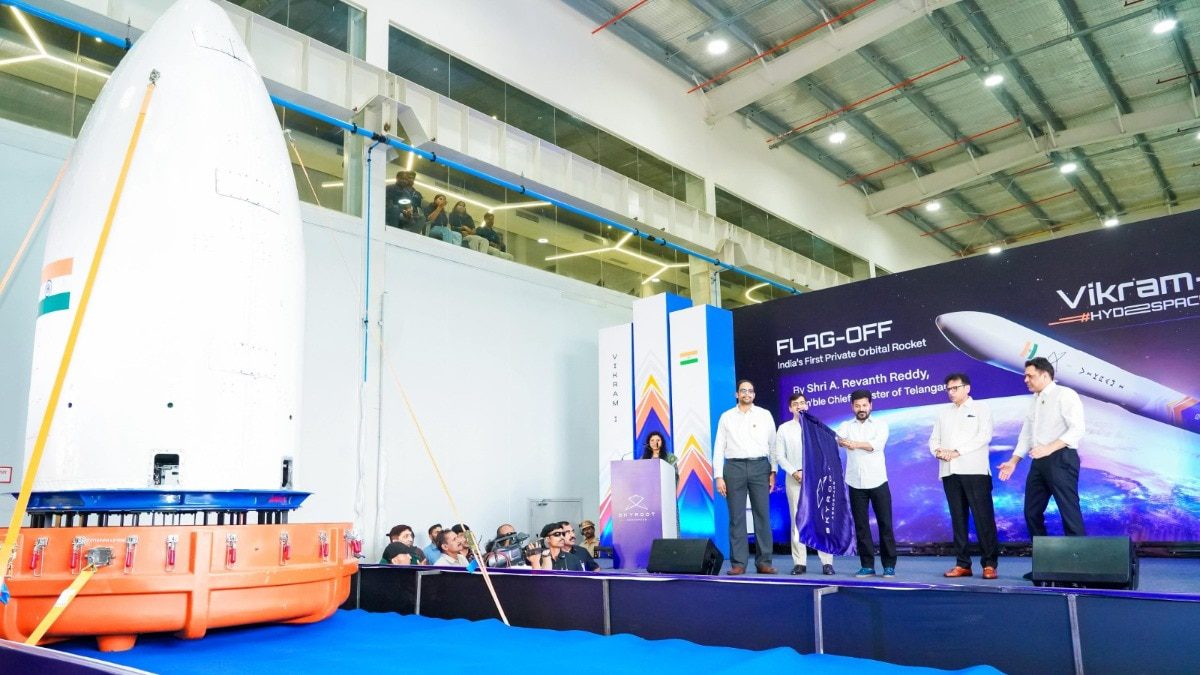
On 25 April 2026 at SDSC-SHAR Sriharikota, Hyderabad-based Skyroot Aerospace flagged off the payload fairing of Vikram-1 — India’s first private-built orbital launch vehicle. The multi-stage rocket combines solid and liquid fuel engines, uses a 3D-printed cryogenic-grade engine, an all-carbon-composite airframe, and is rated to inject up to 350 kg into Low Earth Orbit (LEO, 160–2000 km). Telangana CM A Revanth Reddy attended the ceremony; launch is scheduled later in 2026. The vehicle is named after Dr Vikram Sarabhai, the father of the Indian space programme. Skyroot’s earlier Vikram-S (suborbital, 18 November 2022 from Sriharikota) was India’s first private rocket — Vikram-1 will be its first private orbital one.
Constitutional / Legal Framework
- Indian Space Policy, 2023 — opened the space sector to private players; designates ISRO as R&D, NSIL as commercial arm, IN-SPACe as authoriser/regulator.
- IN-SPACe — Indian National Space Promotion and Authorization Centre; established 2020, headquartered Ahmedabad; single-window for non-government entities (NGEs).
- NSIL — NewSpace India Limited (2019); commercial arm of DoS, executes commercial launches and satellite services.
- Outer Space Treaty (OST), 1967 — Article I (free use, benefit of all mankind), Article II (no national appropriation), Article VI (State responsibility for activities by non-governmental entities), Article VII (international liability).
- Liability Convention, 1972 — launching State is absolutely liable for damage caused by its space objects on Earth’s surface or to aircraft in flight.
- Registration Convention, 1976 — requires States to register space objects with the UN Office for Outer Space Affairs (UNOOSA).
- Rescue Agreement, 1968 — duty to rescue and return astronauts and return space objects.
- Indian Space Act (Draft) — work-in-progress framework for FDI, liability allocation between Government and private players, and licensing.
- Other Indian private space players — AgniKul Cosmos (3D-printed Agnibaan), Pixxel (hyperspectral imaging), Bellatrix Aerospace (electric propulsion), Dhruva Space (satellite platforms).
Why This Matters for CLAT 2027
Space law is a rising CLAT favourite. Expect a Legal Reasoning passage built on OST Article VI — “States bear international responsibility for national activities in outer space, including those carried on by non-governmental entities” — asking you to apply it to Skyroot or AgniKul: even a private launch makes India internationally liable. Test yourself on the OST + Liability Convention + Registration Convention triad. Also possible: a comparative question on Vikram-S (suborbital, 2022) vs Vikram-1 (orbital, 2026) — both Skyroot, but only the latter crosses the Karman line into orbit. Watch for FDI in space (100% under automatic route up to satellite manufacturing per Feb 2024 reform).
Key Facts at a Glance
| Date | 25 April 2026 |
| Company | Skyroot Aerospace (Hyderabad) |
| Vehicle | Vikram-1 — multi-stage orbital launch vehicle |
| Capacity | Up to 350 kg to LEO (160–2000 km) |
| Engines | Solid + liquid; 3D-printed engine; carbon-composite airframe |
| Launch site | SDSC-SHAR, Sriharikota (Andhra Pradesh) |
| Predecessor | Vikram-S — India’s first private rocket (suborbital, 18 Nov 2022) |
| Named after | Dr Vikram Sarabhai (Father of Indian Space Programme) |
| Regulator | IN-SPACe (since 2020); policy: Indian Space Policy 2023 |
| Key UN Treaties | OST 1967, Liability 1972, Registration 1976 |
Mnemonic / Memory Hook
“O-L-R-R” — the four UN space-law treaties India has signed: OST 1967, Liability 1972, Registration 1976, Rescue 1968. For India’s institutional matrix recall “I-N-D” = ISRO (R&D), NSIL (commercial), DoS+IN-SPACe (regulator/authoriser). Vikram-S = Suborbital 2022, Vikram-1 = Orbital 2026 — “S then 1” tracks ascending complexity.
Test Yourself — 10 MCQs
Practice Quiz — 10 CLAT-Style Questions
Click an option to reveal the answer and explanation.