
CURRENT AFFAIRS | MAY 6, 2026
CLAT GK + SCIENCE & TECHNOLOGY
IAF Group Captain Shubhanshu Shukla made history by becoming the first Indian to visit the International Space Station (ISS) as part of Axiom Mission 4 (AX-4). Launched from Kennedy Space Center aboard SpaceX Crew Dragon on June 25, 2025, Shukla spent approximately 20 days aboard the ISS. He is only the second Indian in space overall — the first being Wing Commander Rakesh Sharma in 1984. This is a landmark moment for India’s Gaganyaan programme and space aspirations.
Axiom Mission 4 (AX-4) — Key Details
Axiom Space is a private space company headquartered in Houston, USA. It operates private commercial missions to the ISS under agreement with NASA. AX-4 is the fourth such private astronaut mission.
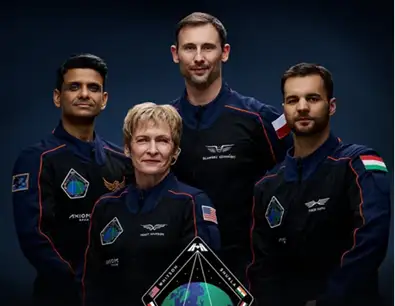
AX-4 Crew:
- Peggy Whitson (USA) — Mission Commander; former NASA astronaut; holds record for most spacewalks by a woman
- Shubhanshu Shukla (India/ISRO) — Mission Pilot; IAF Group Captain; ISRO-selected Gaganyatri
- Slawosz Uznanski-Wisniewski (Poland/ESA) — Mission Specialist
- Tibor Kapu (Hungary/ESA) — Mission Specialist
The mission docked at the ISS on June 26, 2025. Experiments included seed germination in microgravity, muscle atrophy prevention research, microbial adaptation, and human cell aging studies — critical data for the Gaganyaan human spaceflight programme.
Constitutional Framework: Space Under the Constitution
Space technology and the Constitution: Space exploration was not anticipated when the Indian Constitution was drafted in 1949-50. It therefore falls under Entry 97 of Union List (List I) — Residuary Powers, read with Article 248, which gives Parliament exclusive legislative power on any matter not enumerated in the State List or Concurrent List.
Article 51(c) (Directive Principle): “The State shall endeavour to foster respect for international law and treaty obligations.” This underpins India’s adherence to the Outer Space Treaty 1967.
ISRO: Established August 15, 1969; HQ: Bengaluru, Karnataka; under the Department of Space which reports directly to the Prime Minister’s Office.
Space Activities Act 2017: India’s first domestic legislation for regulation of space activities; establishes a licensing regime for government and private entities engaging in space activities.
India in Space: A Historic Timeline
| Year | Event |
| 1969 | ISRO established (August 15) |
| 1975 | Aryabhata — India’s first satellite (launched by Soviet Union) |
| 1984 | Rakesh Sharma — first Indian in space; Soyuz T-11 to Salyut-7; famous “Saare Jahan Se Achha” quote |
| 2008 | Chandrayaan-1 — India’s first lunar mission; discovered water on Moon |
| 2013-14 | Mangalyaan (MOM) — India’s first Mars mission; first Asian country to reach Mars orbit; in first attempt |
| 2023 | Chandrayaan-3 — first soft landing near Moon’s south pole (August 23, 2023) |
| 2025 (Jun) | Shubhanshu Shukla — first Indian to visit ISS; 2nd Indian in space |
| Upcoming | Gaganyaan — India’s first crewed spaceflight; LVM-3 rocket; 400 km orbit; 3-day mission |
CLAT Angle: Gaganyaan Programme
Announced: PM Modi’s Independence Day speech, 2018.
Mission: 3-day crewed mission to Low Earth Orbit at 400 km altitude; 2-3 crew members.
Rocket: LVM-3 (Launch Vehicle Mark 3, formerly GSLV Mk III) — India’s heaviest rocket, payload capacity 8,000 kg to LEO.
4 Gaganyatris (astronaut-designates): Group Captain Shubhanshu Shukla · Group Captain Prasanth Balakrishnan Nair · Group Captain Ajit Krishnan · Wing Commander Angad Pratap — all IAF test pilots, trained in Russia and France.
Historical significance: Gaganyaan will make India the 4th country to independently send humans to space (after USSR/Russia 1961, USA 1961, China 2003 with Yang Liwei aboard Shenzhou 5).
Rakesh Sharma facts (CLAT staple): Wing Commander Rakesh Sharma flew in April 1984 aboard Soviet Soyuz T-11 to Salyut-7 space station. His mission lasted 7 days 21 hours. When PM Indira Gandhi asked “How does India look from up there?”, he replied “Saare Jahan Se Achha”.
Key Facts Table for CLAT Revision
| Fact | Detail |
| Shubhanshu Shukla rank | Group Captain, Indian Air Force |
| AX-4 launch vehicle | SpaceX Crew Dragon; Kennedy Space Center |
| Rakesh Sharma (1984) | Soyuz T-11 to Salyut-7; “Saare Jahan Se Achha” |
| ISS launched | 1998; altitude ~408 km; 15.5 orbits/day |
| ISS partners | NASA (USA), Roscosmos (Russia), JAXA (Japan), ESA (Europe), CSA (Canada) |
| Outer Space Treaty | 1967; space = province of all mankind; no national appropriation |
| Gaganyaan rocket | LVM-3 (GSLV Mk III) |
| India will be how-manyth country | 4th (after Russia, USA, China) |
| ISRO founded | August 15, 1969; HQ Bengaluru |
| Axiom Space HQ | Houston, USA (private company) |
Memory Mnemonic
India’s space timeline: “ISRO 1969 — Rakesh 1984 — Mangalyaan 2014 — Chandrayaan-3 2023 — Shubhanshu 2025 — Gaganyaan upcoming”
Rakesh Sharma vs Shubhanshu: Rakesh = Soviet mission (Soyuz/Salyut-7, 1984); Shubhanshu = US private mission (SpaceX/ISS, 2025)
Outer Space Treaty 1967: “Space = Humanity’s Commons” — like the high seas, no nation can own it.
Test Your Knowledge: Space Science MCQs
Practice Quiz — 10 CLAT-Style Questions
Click an option to reveal the answer and explanation.