CURRENT AFFAIRS | 11 APRIL 2026
CLAT GK + ENVIRONMENTAL LAW
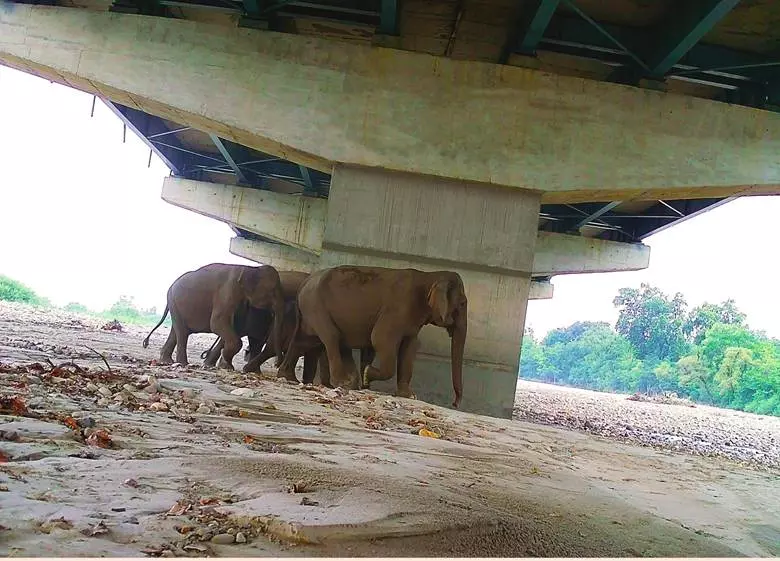
In a landmark moment for wildlife conservation and infrastructure planning in India, the Wildlife Institute of India (WII) has recorded the first evidence of wildlife movement through the underpasses constructed along the Delhi-Dehradun Expressway — one of Asia’s largest wildlife corridors spanning 213 kilometres.
The study, conducted over a 40-day monitoring period on a 12-kilometre stretch near Dehradun, deployed 150 high-tech cameras and 29 acoustic recorders. The result? A staggering 11,353 images documenting the movement of elephants, golden jackals, deer, and other species through the purpose-built wildlife underpasses. The golden jackal was the most frequently captured animal.
Why This Matters for India’s Conservation Framework
India’s development trajectory has long grappled with the tension between infrastructure expansion and ecological preservation. The Delhi-Dehradun Expressway represents a paradigm shift — proving that sustainable development is not merely a theoretical concept but a practical possibility when infrastructure design incorporates wildlife corridors from the planning stage.
The expressway cuts through the Rajaji-Haridwar corridor, a critical elephant habitat. Without the underpasses, the expressway would have fragmented wildlife habitats, leading to increased human-animal conflict, genetic isolation of animal populations, and potential local extinctions. The successful use of underpasses demonstrates that engineering solutions can coexist with ecological imperatives.
The Constitutional and Legal Framework
India’s commitment to environmental protection is deeply embedded in its constitutional architecture. Article 48A, a Directive Principle of State Policy inserted by the 42nd Amendment (1976), directs the State to “protect and improve the environment and to safeguard the forests and wildlife of the country.” Complementing this is Article 51A(g), a Fundamental Duty requiring every citizen to “protect and improve the natural environment including forests, lakes, rivers and wildlife, and to have compassion for living creatures.”
The Wildlife Protection Act, 1972 provides the statutory framework, establishing protected areas, regulating hunting, and creating the institutional machinery (National Board for Wildlife, Chief Wildlife Wardens) necessary for implementation. The Act has been amended multiple times, most recently strengthening penalties and expanding the list of protected species.
Judicial Evolution: From Vellore to Godavarman
The Supreme Court has been instrumental in developing India’s environmental jurisprudence. In Vellore Citizens’ Welfare Forum v Union of India (1996), the Court recognized the precautionary principle and the polluter pays principle as part of Indian law, establishing that sustainable development is a constitutional requirement, not merely a policy preference.
In MC Mehta v Kamal Nath (1997), the Court applied the Public Trust Doctrine, holding that natural resources like rivers, forests, and wildlife are held by the State as a trustee for the benefit of the public. Any action that destroys or diminishes these resources violates this trust.
The TN Godavarman Thirumulkpad v Union of India case, ongoing since 1996, revolutionized forest conservation by expanding the definition of “forest” beyond its Revenue Department classification to include all areas that are forests in the dictionary sense — regardless of ownership or classification.
Sustainable Development in Practice
The Delhi-Dehradun Expressway’s wildlife corridors represent the practical application of sustainable development — the principle that development must meet present needs without compromising the ability of future generations to meet their own needs. The Brundtland Commission’s definition, adopted by the Supreme Court in Vellore Citizens, finds its clearest expression in infrastructure projects that actively plan for ecological coexistence.
Constitutional & Legal Framework
- Article 48A (DPSP): State shall protect and improve the environment, safeguard forests and wildlife
- Article 51A(g) (Fundamental Duty): Citizens must protect natural environment including wildlife
- Wildlife Protection Act, 1972: Statutory framework for wildlife protection, protected areas, hunting regulation
- 42nd Amendment (1976): Inserted Art 48A and Art 51A(g); moved forests/wildlife to Concurrent List
- Environment Protection Act, 1986: Umbrella legislation for environmental protection
CLAT Angle — Why This Matters for You
- Passage-based questions: Expect a passage on wildlife corridors testing your understanding of Art 48A vs Art 51A(g) (DPSP vs Fundamental Duty)
- Legal Reasoning: Apply the Public Trust Doctrine (MC Mehta v Kamal Nath) to infrastructure projects
- Principle-Application: Balance development needs against environmental protection — the sustainable development principle from Vellore Citizens
- Current Affairs + Legal Knowledge: CLAT frequently tests the intersection of current events with constitutional provisions
Key Facts at a Glance
| Expressway Length | 213 km (one of Asia’s largest wildlife corridors) |
| Monitoring Period | 40 days on 12-km stretch near Dehradun |
| Equipment Deployed | 150 cameras + 29 acoustic recorders |
| Images Captured | 11,353 images documented |
| Most Captured Animal | Golden Jackal |
| Monitoring Body | Wildlife Institute of India (WII) |
| Key Species Recorded | Elephants, golden jackals, deer |
Mnemonic: “WILDLIFE PASS”
Wildlife Institute of India — monitoring body
Images — 11,353 documented
Length — 213 km expressway
Dehradun — 12 km stretch monitored
Law — Wildlife Protection Act 1972
Infrastructure — underpasses for safe crossing
Forty days — monitoring period
Elephants, jackals, deer — species recorded
Public Trust — MC Mehta v Kamal Nath
Art 48A — DPSP for environment
Sustainable Development — Vellore Citizens case
Safeguard — Art 51A(g) Fundamental Duty
Practice Quiz — 10 CLAT-Style Questions
Click an option to reveal the answer and explanation.