CURRENT AFFAIRS | MAY 5, 2026
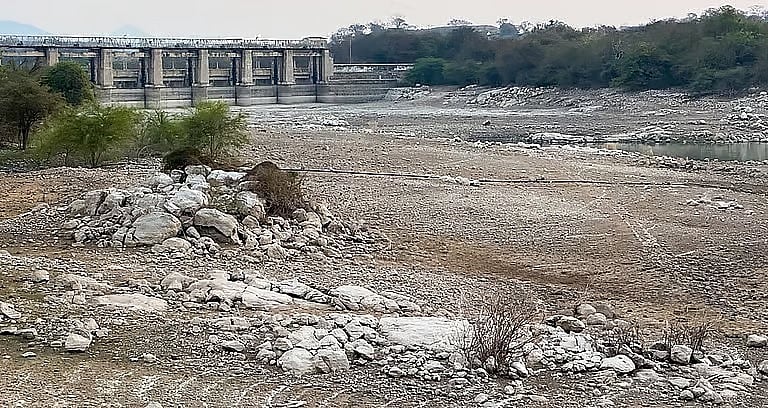
The Central Water Commission’s (CWC) latest weekly Reservoir Storage Bulletin has flagged a deepening water-stress signal — live storage in eight Indian states has fallen below 40% of capacity, with three river basins now in critical condition. The CWC monitors 155 important reservoirs nationally on a weekly basis (every Thursday), and a sub-40% reading is the customary tripwire for irrigation, drinking-water and hydropower planners. For CLAT 2027 aspirants, this is a textbook setting to revise Article 262, the Inter-State River Water Disputes Act 1956, the National Water Policy 2012, and the public-trust doctrine.
Why This Matters Right Now
Live storage below 40% in eight states — concentrated in southern and western India — directly stresses summer kharif sowing, urban water supply and hydroelectric generation. The CWC’s bulletin function is administrative but feeds directly into legal triggers: a state may approach the Centre under the 1956 Act for a tribunal reference if interstate flows are altered.
Constitutional Framework
- Article 262 — Parliament may by law provide for adjudication of disputes relating to waters of inter-state rivers; the Inter-State River Water Disputes Act 1956 is the operative statute.
- Article 246 + Seventh Schedule — Entry 17 List II places water under the State List; Entry 56 List I empowers the Union on inter-state rivers and river valleys.
- Article 21 — In Subhash Kumar v State of Bihar (1991), the Supreme Court held that the right to clean and pollution-free water flows from the right to life.
- Article 48A + 51A(g) — Directive Principle and Fundamental Duty to protect and improve the natural environment.
CLAT Angle
Expect a passage-based question testing the layered jurisdiction over water — State List versus Union List on inter-state rivers, the constitutional lift to Article 21 in Subhash Kumar, and the public-trust doctrine recognised in MC Mehta v Kamal Nath (1996). The Cauvery dispute provides the standard fact-pattern. Watch for fact-application questions framed around drought-year tribunal references and Article 262 institutional design.
Key Facts
| Element | Detail |
|---|---|
| Bulletin issuer | Central Water Commission (CWC), Ministry of Jal Shakti |
| Reservoirs monitored | 155 (weekly, every Thursday) |
| States below 40% | 8 (south + west India concentrated) |
| River basins critical | 3 |
| Governing statute | Inter-State River Water Disputes Act 1956 (Article 262) |
| Lead policy | National Water Policy 2012 |
Mnemonic — “262 = TWO ResErvoirs”
262 → Tribunal for Water On inter-state Rivers; Entry 56 (Union List) for Union supremacy. Pair it with 1956 Act and 2012 Policy.
Practice Quiz — 10 Questions
Test your understanding of CWC, Article 262, public-trust doctrine and inter-state water tribunals.
Practice Quiz — 10 CLAT-Style Questions
Click an option to reveal the answer and explanation.
Read more daily current affairs for CLAT 2027 aspirants on CLAT Gurukul.