
CURRENT AFFAIRS | 21 APRIL 2026
CLAT GK | INTERNATIONAL RELATIONS | TRADE LAW | CONSTITUTIONAL ARTICLE 253
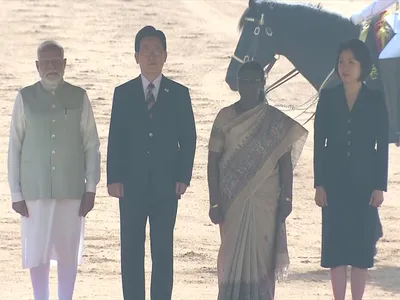
On April 20, 2026, Prime Minister Narendra Modi met Republic of Koreas President Lee Jae Myung at Hyderabad House for the most consequential India-Korea summit in nearly a decade. President Droupadi Murmu received President Lee at Rashtrapati Bhavan earlier in the day — the first visit by a South Korean President to India in eight years.
The headline deliverable: a commitment to take bilateral trade from the current ~USD 27 billion to USD 50 billion by 2030, anchored by an agreement to restart negotiations on upgrading the Comprehensive Economic Partnership Agreement (CEPA), in force since January 1, 2010.
Key Facts at a Glance
| Metric | Value |
|---|---|
| Current bilateral trade | ~USD 27 billion (FY2025) |
| Target by 2030 | USD 50 billion |
| Indias imports from Korea | ~USD 21 billion |
| Indias exports to Korea | ~USD 5.8 billion |
| CEPA in force since | 1 January 2010 |
“Chips to Ships” — The New Pillars
- India-Korea Financial Forum — institutional channel for fintech and cross-border investment.
- Industrial Cooperation Committee — ministry-level tracking on manufacturing.
- Economic Security Dialogue — supply chains, AI, semiconductors — a direct response to China-plus-one re-shoring.
- Korean Industrial Township — dedicated Korean-owned manufacturing zones in India.
- MoUs signed — shipbuilding, sustainability, steel, ports, India-Korea Digital Bridge.
- India-Korea Friendship Festival 2028 — cultural exchange anchor.
Constitutional & Legal Framework
- Article 253 — empowers Parliament to make any law for the whole or any part of India for implementing any treaty, agreement or convention with another country. CEPAs domestic enforcement flows from here.
- Article 51 (DPSP) — directs the State to foster respect for international law and treaty obligations; promotes international peace.
- Seventh Schedule, Union List Entry 14 — “Entering into treaties and agreements with foreign countries” — a Union subject.
- WTO / GATT Article XXIV — the legal carve-out that permits bilateral FTAs/CEPAs to deviate from the Most Favoured Nation (MFN) principle.
- S.R. Bommai v Union of India (1994) — federalism is part of the basic structure; states cannot independently negotiate foreign trade, but the Constitution Benchs federalism doctrine constrains how the Union implements treaty obligations that affect state subjects.
Arguments: Why Upgrade CEPA Now?
For India: The current CEPA has produced a widening trade deficit (Korea runs a ~USD 15 billion surplus with India). Upgrading means addressing tariff asymmetries, pushing for easier market access for Indian pharmaceuticals, IT services and agricultural products, and ensuring Koreas semiconductor investments genuinely land in India.
For Korea: Post-pandemic supply-chain diversification away from China is a strategic imperative. Samsung, LG, Hyundai and SK Hynix need scale partners; India offers market depth and (via PLI schemes) manufacturing incentives.
Shared: Both nations are Indo-Pacific democracies anchoring the Indo-Pacific Oceans Initiative (IPOI) launched by PM Modi in 2019 and Koreas own Indo-Pacific framework. The International Solar Alliance, clean-energy cooperation and defence indigenisation are overlapping agendas.
Mnemonic
CHIPS — CEPA upgrade (2010), Hyderabad House summit, Industrial Township, Ports & shipbuilding MoUs, Semiconductors + ships + steel.
CLAT 2027 Angle — What to Memorise
- Article 253 + Union List Entry 14 is a classic Constitutional Law MCQ combination — Parliament alone legislates for treaty implementation.
- The federalism tension from S.R. Bommai (1994) re-emerges when a CEPA touches State-List subjects (e.g., agriculture, fisheries) — good Legal Reasoning territory.
- WTO framework: MFN principle (GATT Article I) vs the FTA exception (GATT Article XXIV) — expect direct factual MCQs.
- Indo-Pacific vocabulary: IPOI (2019), IPEF, Quad, SAGAR — know which is Indian, which is US-led, which is multilateral.
Test Your Understanding — 10 MCQs
Apply what you just read. Explanations appear after each answer.
Practice Quiz — 10 CLAT-Style Questions
Click an option to reveal the answer and explanation.