CURRENT AFFAIRS | 21 APRIL 2026
CLAT GK | INTERNATIONAL RELATIONS | STRATEGIC AUTONOMY | UN CHARTER
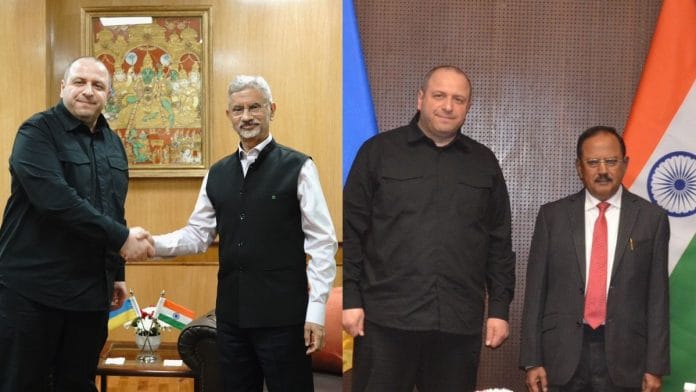
Ukraine President Volodymyr Zelenskyy announced on April 20, 2026, via a social media post on X, that India and Ukraine are finalising an enhanced security cooperation arrangement, with formal documents in the final stages of drafting. The announcement caps a week of high-level diplomacy: Ukraines National Security and Defence Council Secretary Rustem Umerov met Indias National Security Adviser Ajit Doval and External Affairs Minister S. Jaishankar on Friday, April 17.
NSA Doval conveyed Indias “principled position and focus on peaceful resolution through dialogue and diplomacy” — a phrasing carefully calibrated to signal engagement without endorsing either belligerent. Umerovs public response: “more security arrangements are forthcoming” and “air defense for Ukraine and support for our army remain constant priorities.” Russian Foreign Minister Sergey Lavrov is expected in New Delhi in mid-May — classic Indian strategic autonomy choreography.
Key Facts at a Glance
| Item | Detail |
|---|---|
| Russia-Ukraine war | Entered 5th year; began Feb 2022 |
| PM Modis Kyiv visit | 23 August 2024 (first by Indian PM) |
| Ukraine official visiting | Rustem Umerov (NSDC Secretary) |
| Russian FM expected | Sergey Lavrov, mid-May 2026 |
| Indian position | Dialogue & diplomacy; strategic autonomy |
Constitutional & International Legal Framework
- Article 51 of the Indian Constitution (DPSP, Part IV) — directs India to (a) promote international peace and security, (b) maintain just and honourable relations, (c) foster respect for international law, and (d) encourage settlement of international disputes by arbitration. Indias Ukraine posture flows directly from this.
- UN Charter Article 2(4) — prohibits the threat or use of force against the territorial integrity or political independence of any state.
- UN Charter Article 51 (distinct from Indian Constitutions Article 51) — recognises the inherent right of individual or collective self-defence if an armed attack occurs.
- Strategic autonomy doctrine — contemporary articulation of Indias independent foreign-policy posture, distinct from classical non-alignment; enables simultaneous engagement with Russia (S-400, BrahMos), Ukraine (security cooperation), US (Quad), and the Global South.
- Defence Offset Guidelines (Ministry of Defence, under Defence Acquisition Procedure) — govern any defence supply arrangement India may enter with Ukraine.
Arguments: Why Deepen Ties With Ukraine?
For India: Ukraine is a major source of sunflower oil, fertilisers (before the war, India imported ~70% of its sunflower oil from Ukraine and Russia combined) and, historically, defence components (Antonov aircraft parts, gas-turbine engines for naval ships). A security cooperation framework protects Indian interests in rebuilding and unlocks fresh defence-industrial ties.
For Ukraine: India is the worlds most populous democracy, a G20 power, and a major Global South voice. Indian endorsement — even of a procedural peace process — has diplomatic weight the G7 alone cannot deliver.
The tightrope: India buys ~40% of its crude oil from Russia at discounted rates post-2022 sanctions; it also needs Ukrainian grain corridors, Ukrainian IT talent, and Ukrainian technology transfers. Balancing both while hewing to Article 51 DPSP is the defining test of multi-alignment.
Mnemonic
SHIELD — Strategic autonomy, Human costs (dialogue over force), India-Ukraine 2024 Joint Statement, Enhanced security MoU (Apr 2026), Lavrov visit mid-May, Doval-Umerov talks.
CLAT 2027 Angle — What to Memorise
- Article 51 DPSP — common confusion with UN Charter Article 51 (self-defence); do not mix the two in exam answers.
- Strategic autonomy is not the same as non-alignment 1.0; examiners often trap students on this evolution from Nehru-era to post-1991.
- India-Russia Defence offsets, BrahMos missile, S-400 — background knowledge anchors Legal Reasoning passages on export controls.
- Quad, I2U2, SCO, BRICS — know which India is in, which it is not, and what each forum does.
- Indias abstention pattern in UN General Assembly votes on Ukraine is CA + CL territory — memorise the 2022, 2023, 2024 vote counts.
Test Your Understanding — 10 MCQs
Apply what you just read. Explanations appear after each answer.
Practice Quiz — 10 CLAT-Style Questions
Click an option to reveal the answer and explanation.