
CURRENT AFFAIRS | 1 APRIL 2026
CLAT GK + INTERNATIONAL RELATIONS & CONSTITUTIONAL LAW
– Japan Constitution Article 9 (renunciation of war)
– US-Japan Security Treaty (1951/1960)
– QUAD (Quadrilateral Security Dialogue) and Indo-Pacific strategy
– UN Charter Article 51 (right to self-defense)
– Post-WWII constitutional constraints on military
What Happened: Japan’s Historic Missile Deployment
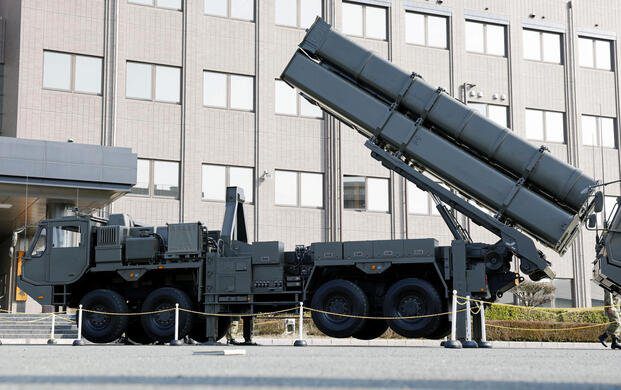
Japan on 31 March 2026 deployed its first long-range missile — the upgraded Type-12 land-to-ship missile — at Camp Kengun in Kumamoto prefecture, southwestern Japan. Built by Mitsubishi Heavy Industries, the missile has a range of approximately 1,000 km (620 miles), a massive extension from the original 200 km range.
Defense Minister Shinjiro Koizumi called it “an extremely important capability to strengthen Japan’s deterrence and responsiveness” that “demonstrates Japan’s firm determination and capability to defend itself.”
Additional developments on the same day:
- A hypersonic glide vehicle (HGV) was deployed at Camp Fuji in Shizuoka prefecture
- Japan plans to deploy US-made Tomahawk cruise missiles (1,600 km range) on destroyer JS Chokai later this year
- Additional deployments planned at Hokkaido and Miyazaki by March 2028
- PM Sanae Takaichi’s Cabinet approved a record defense budget exceeding 9 trillion yen ($58 billion)
Article 9 of the Japanese Constitution (1947):
“Aspiring sincerely to an international peace based on justice and order, the Japanese people forever renounce war as a sovereign right of the nation and the threat or use of force as means of settling international disputes.”
Paragraph 2: “Land, sea, and air forces, as well as other war potential, will never be maintained.”
The Reinterpretation: Despite this text, Japan has maintained Self-Defense Forces (SDF) since the Self-Defense Forces Act, 1954. In 2014, Japan reinterpreted Article 9 to allow collective self-defense — meaning Japan can use force to defend allies under attack, not just itself.
Counterstrike Capability: Japan’s new policy allows strikes on enemy missile launch sites and command centers — a significant shift from its purely defensive posture.
Strategic Context: Indo-Pacific Security
Japan considers China its main regional security threat and has been fortifying its southwestern islands near the East China Sea. Japan faces what officials call the “most severe security environment in the postwar era.”
| Missile | Upgraded Type-12 (land-to-ship) |
| Range | ~1,000 km (upgraded from 200 km) |
| Manufacturer | Mitsubishi Heavy Industries |
| Deployment Location | Camp Kengun, Kumamoto |
| Defense Minister | Shinjiro Koizumi |
| Defense Budget | 9+ trillion yen ($58 billion) |
| Constitutional Provision | Article 9 (renunciation of war) |
| QUAD Members | US, Japan, India, Australia |
Key Treaties and Alliances
- US-Japan Security Treaty (1951/1960): The Treaty of Mutual Cooperation and Security — US commits to Japan’s defense; Japan provides military bases to the US
- QUAD: The Quadrilateral Security Dialogue comprising US, Japan, India, and Australia — focuses on a free and open Indo-Pacific
- UN Charter Article 51: Japan’s legal basis for self-defense — the inherent right of individual or collective self-defense
– GK Section: Article 9 (pacifist clause), Type-12 missile, Camp Kengun, Kumamoto, QUAD
– Legal Reasoning: Constitutional reinterpretation — can a pacifist constitution allow offensive weapons?
– Comparative Law: India Art 51 (DPSP — promotion of international peace) vs Japan Art 9 (renunciation of war)
– International Relations: China as a security threat, Taiwan strait tensions, Indo-Pacific strategy
– Treaty Law: US-Japan Security Treaty, QUAD — collective defense mechanisms
J — JSDF (Self-Defense Forces Act 1954)
A — Article 9 (renunciation of war)
P — Pacifist constitution reinterpreted
A — Alliance with US (Security Treaty 1951)
N — New Type-12 missile at 1,000 km range
Source: Military.com, ABC News, Washington Post, Japan Times, Army Recognition — 31 March 2026
Practice Quiz
Test your understanding with these 10 MCQs:
Practice Quiz — 10 CLAT-Style Questions
Click an option to reveal the answer and explanation.