

CURRENT AFFAIRS | 30 APRIL 2026
CLAT GK + Science & Technology / Education
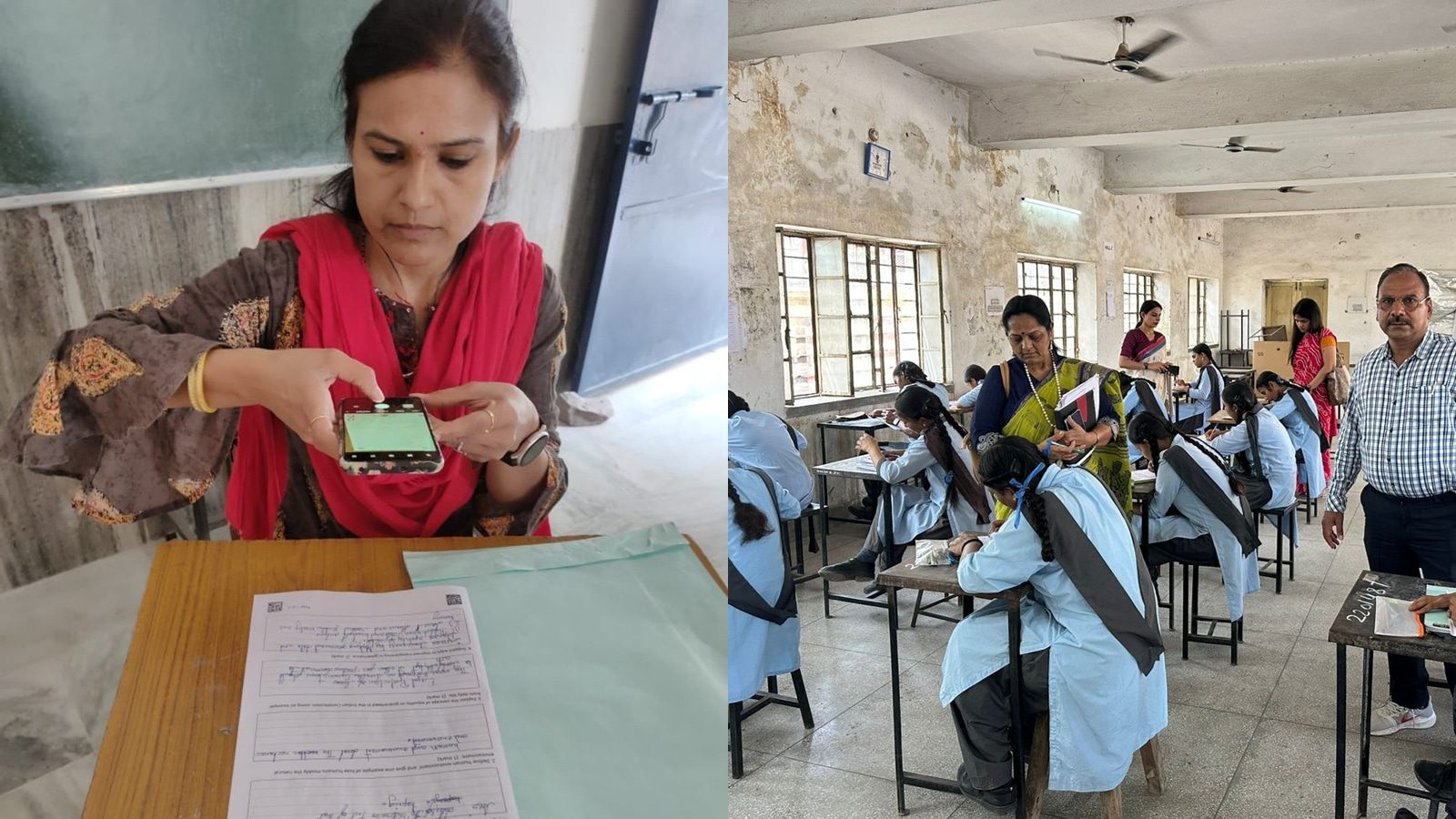
The Jodhpur district administration, in partnership with the Education Department, DIET, EdOptimize, and PSU Central Electronics Ltd (CEL), has rolled out Phase 2 of its Competency-Based Census Assessment & School Reporting Pilot Project. The exercise covers approximately 1,000 government schools across all 15 blocks of the district and uses an AI-powered app to scan, grade and analyse student answer sheets in 5 to 7 minutes per sheet — a job that traditionally takes hours.
The numbers are large: ~70,000 students of Classes 6 to 9 across 5 subjects (English, Hindi, Maths, Science, Social Science) — totalling 3+ lakh assessments. Each child receives a personalised report card with 0–3 stars per topic. For example, the Indian Express profiles a student named Jivraj scoring an excellent 3/3 on “understanding democratic governance” but only 1/3 on “applying science to everyday life” — exactly the granular learning-gap data parent-teacher meetings in government schools have lacked.
What Happened
The AI app processes both objective MCQs and short-form subjective answers. Phase 1 had covered 54 government schools in October 2025; Phase 2 scales the model 18× to ~1,000 schools. The output: a personalised report card per student, ranked competency-by-competency, used to guide teacher remediation and parent dialogue. The aim is squarely Aligned with the National Education Policy (NEP) 2020 shift from rote learning to competency-based learning and Foundational Literacy and Numeracy (FLN).
The Background
NEP 2020 mandates competency-based assessments and the establishment of PARAKH (Performance Assessment, Review, and Analysis of Knowledge for Holistic Development) as a national assessment centre under NCERT. PARAKH is meant to standardise how state, central and international boards evaluate students — moving away from one-shot board exams toward continuous, diagnostic and formative assessment.
Constitutional & Legal Framework
- Article 21A — fundamental right to free and compulsory education for children aged 6–14 (added by 86th Constitutional Amendment, 2002).
- Right to Education (RTE) Act, 2009 — Section 29 — empowers the Academic Authority to lay down curriculum and evaluation procedure; the legal hook for competency-based assessments.
- Concurrent List, Seventh Schedule — Education was moved from State List to Concurrent List by the 42nd Amendment, 1976, enabling joint Centre-State action on policies like NEP 2020.
- NEP 2020 + NIPUN Bharat Mission — push for FLN by Grade 3 and competency-based assessments.
- Mohini Jain v. State of Karnataka (1992) and Unni Krishnan v. State of A.P. (1993) — Supreme Court cases foundational to the right to education.
Why This Matters
India’s biggest learning crisis isn’t access — it’s quality and personalisation. The ASER 2024 report showed huge gaps in reading and arithmetic across rural India. AI-led, per-child diagnostic reporting at scale is one of the most promising responses, especially for resource-thin government schools. Jodhpur’s pilot, if it succeeds, becomes a template for the National Mission on Foundational Literacy.
CLAT 2027 — Why You Must Know This
Cuts across GK (NEP 2020, PARAKH, RTE), Legal Reasoning (Art 21A, RTE Sec 29), and Logical Reasoning (cause-effect of competency vs rote testing). A passage-based question on Article 14’s “substantive equality” + AI-personalised assessment is a high-probability framing.
Key Facts at a Glance
| PROJECT | Competency-Based Census Assessment & School Reporting (Phase 2) |
| PARTNERS | Jodhpur Admin + Education Dept + DIET + EdOptimize + CEL (PSU) |
| SCALE | ~1,000 schools, 15 blocks, ~70,000 students (Classes 6–9) |
| SUBJECTS | English, Hindi, Maths, Science, Social Science |
| AI APP TIME | 5–7 minutes per answer sheet |
| PHASE 1 | 54 schools, October 2025 |
| POLICY ANCHOR | NEP 2020 + PARAKH (NCERT) + RTE Sec 29 |
Mnemonic
PARAKH = Performance Assessment, Review, and Analysis of Knowledge for Holistic Development. Hindi parakhna = “to test/judge”.
Test Your Knowledge — 10 Question Quiz
Take this quick quiz to lock in the concepts:
Practice Quiz — 10 CLAT-Style Questions
Click an option to reveal the answer and explanation.
Source: The Indian Express, 30 April 2026.






