
CURRENT AFFAIRS | 2 MAY 2026
CLAT GK + INFRASTRUCTURE LAW (NH ACT, LARR 2013, BHARATMALA)
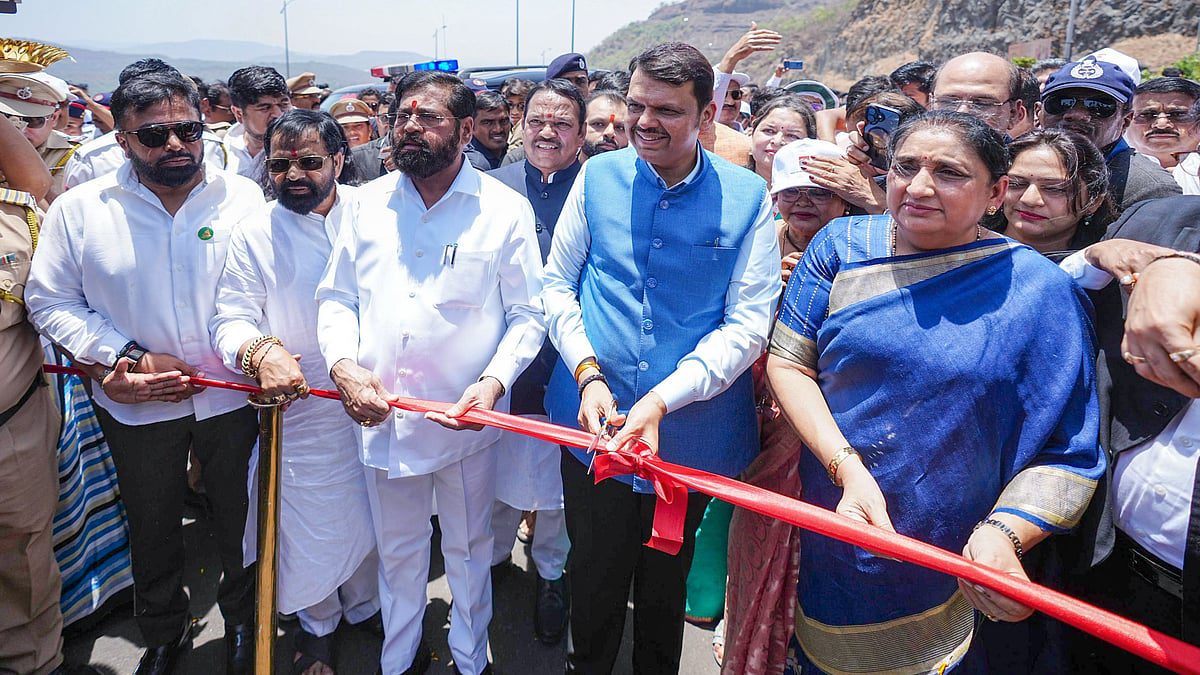
After nearly a decade of construction, Maharashtra Chief Minister Devendra Fadnavis on Friday, 1 May 2026 (Maharashtra Day), inaugurated the long-awaited Missing Link project on the Mumbai-Pune Expressway. The 13.3 km corridor cuts through the rugged Sahyadri (Western Ghats) hills, bypassing the accident-prone Khandala Ghat section, slashing 6 km off the route and shaving roughly 30 minutes off commute time. Deputy CMs Eknath Shinde and Sunetra Pawar accepted the Guinness World Records certificate alongside Fadnavis.
The headline engineering feat: two parallel tunnels — 1.6 km and 8.9 km long — each 22.3 metres wide, now officially the world’s widest underground tunnels as certified by Guinness. The corridor also features a stunning cable-stayed bridge over Tiger Valley, soaring 182 metres above the deepest stratum, designed to withstand sustained winds of 240 km/h — among the toughest design specifications anywhere in India. The bridge length itself has earned a separate Guinness entry. Construction was led by the Maharashtra State Road Development Corporation (MSRDC) in partnership with Afcons Infrastructure and Navayuga Engineering. Final cost: approximately ₹6,695 crore.
Behind the ribbon-cutting lies a dense legal architecture. National highways and inter-state expressways are governed by the National Highways Act, 1956, under which the Centre declares a road as an NH and either constructs it directly or via Build-Operate-Transfer (BOT) / Hybrid Annuity Mode (HAM) public-private partnerships. State expressways like Mumbai-Pune are administered by State Acts (Maharashtra Highways Act 1955) read with the central scheme. Land acquisition for such corridors is now governed by the Right to Fair Compensation and Transparency in Land Acquisition, Rehabilitation and Resettlement (LARR) Act, 2013, which replaced the colonial Land Acquisition Act 1894 — although a 2015 ordinance attempt to dilute consent and SIA requirements lapsed.
The wider policy frame is set by Bharatmala Pariyojana (Phase-I 2017), the flagship highway-corridor programme aimed at building 34,800 km of economic corridors and feeder routes; Setu Bharatam (2016), which targets making NHs free of railway level crossings via ROBs and RUBs; and PM Gati Shakti (2021), the national master plan for multi-modal infrastructure planning, integrating roads, rail, ports, airports and digital connectivity. The Missing Link is the kind of “engineering marvel as exam-question” that examiners love because it lets them braid together infrastructure law (LARR 2013), constitutional law (Article 19(1)(d) freedom of movement, Entry 23/24 of Union List, Entry 13 of State List), and policy schemes.
An environmental subtext also runs through the project: tunnelling under the Sahyadris triggers obligations under the Environment (Protection) Act, 1986, the Forest Conservation Act, 1980, and EIA Notification 2006. The Western Ghats are an ESZ candidate (Gadgil and Kasturirangan reports), so any major boring activity needs MoEFCC clearance. NGT cases on the corridor have been filed and disposed of over the past decade.
Constitutional & Legal Framework
- National Highways Act, 1956 — declaration, acquisition, maintenance of NHs
- LARR Act, 2013 — fair compensation + R&R for displaced persons
- Article 19(1)(d) — freedom of movement (passively engaged)
- Union List Entry 23 — National Highways; State List Entry 13 — State roads
- Environment Protection Act, 1986 + EIA 2006 + FC Act 1980
- Bharatmala Pariyojana (2017) — 34,800 km economic corridors
- Setu Bharatam (2016) — NH level-crossing elimination
- PM Gati Shakti (2021) — multi-modal infra master plan
Why This Matters for CLAT 2027
Infrastructure questions are CLAT staples — Mumbai Trans-Harbour Link, Atal Setu, Zojila Tunnel, Chenab Bridge have all featured. Expect (a) factual recall on the Guinness record + width, (b) the Act-vs-Scheme distinction (LARR is an Act; Bharatmala is a Scheme), (c) federalism (NH vs State Highway), and (d) environmental angle (Western Ghats, EIA). Legal Reasoning passages may pose a hypothetical “displaced farmer challenges acquisition” — apply LARR Sec 4 (SIA), Sec 38 (consent), and Sec 27 (compensation).
Key Facts at a Glance
| Parameter | Detail |
|---|---|
| Inaugurated by | CM Devendra Fadnavis on 1 May 2026 |
| Length | 13.3 km |
| Tunnel width | 22.3 m (Guinness — world’s widest) |
| Tunnel lengths | 1.6 km + 8.9 km |
| Bridge height | 182 m (Tiger Valley cable-stayed) |
| Wind tolerance | 240 km/h |
| Cost | ₹6,695 crore |
| Executing agency | MSRDC + Afcons + Navayuga |
Mnemonic — “B-S-G” Highway Trinity
Bharatmala (corridors) · Setu Bharatam (level-crossings) · Gati Shakti (multi-modal). Acquisition law: LARR-2013 (replacing 1894).
Practice Quiz — 10 CLAT-Style Questions
Click an option to reveal the answer and explanation.