Last Updated: May 2026
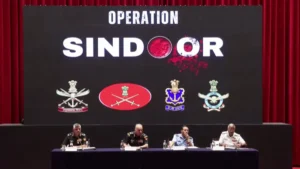
On 7 May 2025, the Indian Armed Forces launched Operation Sindoor, a series of precision strikes on nine terror-infrastructure sites across Pakistan and Pakistan-occupied Kashmir, in response to the Pahalgam terror attack of 22 April 2025 that killed 26 civilians. One year on, in May 2026, the operation has become a fixed reference point in CLAT 2027 current-affairs preparation — not because of the political headlines, but because it is now the most-cited Indian case study in International Humanitarian Law (IHL) classrooms across NLU campuses. This post breaks down what every CLAT 2027 aspirant must know: the timeline, the IHL principles invoked, the UN Charter implications, and how examiners are likely to frame passage-based questions around it.
Operation Sindoor: A Fact-First Timeline
Before any legal analysis, the facts must be locked in. CLAT passages typically open with a chronology and then test whether you can map a legal principle to a specific fact in the passage.
| Date | Event | Legal Touchpoint |
|---|---|---|
| 22 April 2025 | Pahalgam terror attack — 26 civilians killed | Trigger event; “armed attack” question under UN Charter Art. 51 |
| 23 April 2025 | India suspends Indus Waters Treaty obligations | VCLT Art. 60 — material breach as ground for suspension |
| 7 May 2025 (01:05 IST) | Operation Sindoor strikes commence — 9 sites hit | Self-defence claim under Customary IL + Art. 51 |
| 7 May 2025 | Strikes confined to “terror infrastructure”; civilian areas avoided | Distinction principle (IHL); proportionality test |
| 10 May 2025 | India and Pakistan announce understanding on stoppage | De-escalation; ceasefire as state practice |
| May 2026 | One-year retrospective; UN HRC and ICRC commentary published | Opinio juris formation around “non-state-actor self-defence” |
The Core IHL Principles a CLAT Passage Will Test
International Humanitarian Law — the law that applies during armed conflict — rests on four classical principles. Operation Sindoor became a textbook test of all four.
1. Distinction
Parties to a conflict must always distinguish between combatants and civilians, and between military objectives and civilian objects. India’s official briefing emphasised that all nine targets were “non-military” terror infrastructure (training camps, launch pads). Expect a CLAT passage to give you a hypothetical strike list and ask which target violates the distinction principle.
2. Proportionality
An attack is unlawful if the expected incidental civilian harm is excessive in relation to the concrete and direct military advantage anticipated. Proportionality is not a numerical match — it is a qualitative test. CLAT 2027 mocks have already started featuring questions asking students to reject the layperson reading (“they killed 26, so we can kill 26”) and apply the legal test instead.
3. Military Necessity
Force may only be used to achieve a legitimate military objective. Indian government communications repeatedly framed the operation as “measured, non-escalatory and focused” — language deliberately mapped onto the necessity test.
4. Humanity (Unnecessary Suffering)
Even when a strike is otherwise lawful, weapons or methods causing unnecessary suffering are prohibited. Precision-guided munitions used in Sindoor were chosen specifically to satisfy this prong.
UN Charter Article 51 and Self-Defence Against Non-State Actors
This is the most exam-relevant doctrinal question of 2026. Article 51 of the UN Charter recognises the inherent right of self-defence “if an armed attack occurs against a Member of the United Nations”. Two doctrinal points are now consolidated by Indian state practice:
- Self-defence can be invoked against non-state actors operating from another state’s territory, particularly where the host state is “unwilling or unable” to suppress them. India’s diplomatic note framed Pakistan as both unwilling and unable.
- Anticipatory self-defence remains contested, but Sindoor is generally classified as a responsive (not anticipatory) strike, since the Pahalgam attack had already occurred.
For a deeper revision of constitutional and international law cross-references, see our CLAT 2027 syllabus breakdown and the CLAT 2027 FAQ.
Indus Waters Treaty Suspension — A Treaty Law Side-Question
The 23 April suspension of India’s IWT obligations is technically a separate legal episode but is now bundled with Sindoor in passage banks. The relevant rule is Vienna Convention on the Law of Treaties, Article 60: a material breach of a bilateral treaty by one party entitles the other to invoke the breach as a ground for terminating or suspending operation. India’s position: cross-border terrorism constitutes a material breach of the treaty’s preambular obligation of “goodwill and friendship”. Pakistan disputed this. Expect a passage that gives you VCLT Art. 60 verbatim and asks whether IWT suspension was lawful.
How CLAT 2027 Will Likely Frame Questions
Based on the question patterns from 2024 and 2025 papers and the 2026 mock test cycle, current-affairs items rooted in Operation Sindoor will appear in two sections:
- GK / Current Affairs — short factual passage (timeline, casualty figures, names of operations) followed by 4–6 MCQs on dates, places, and who-said-what.
- Legal Reasoning — a longer passage stating an IHL principle or Art. 51 verbatim, then a hypothetical fact pattern (Country X strikes camps in Country Y) where you apply the principle. This is where the marks are.
Sample CLAT-style stem to attempt mentally: “Country A suffers a terror attack from a non-state group based in Country B. Country B’s government denies involvement but takes no action against the group. Country A launches precision strikes on the group’s camps inside Country B, avoiding all military and civilian targets. Which of the following IHL principles is MOST directly satisfied by Country A’s choice of targets?” — the answer is Distinction, not Proportionality, and not Necessity.
What to Read (and What to Skip)
| Source | Use For | Time Investment |
|---|---|---|
| MEA press briefings (April–May 2025) | Official Indian legal framing | 30 min total |
| UN Charter Art. 2(4) and Art. 51 | Verbatim provisions | 15 min |
| Geneva Conventions Common Article 3 | Minimum IHL floor | 20 min |
| ICRC Customary IHL Rules 1, 7, 14 | Distinction, military objectives, proportionality | 30 min |
| The Hindu / Indian Express op-eds (May 2025–May 2026) | Indian policy lens | 1 hour over 6 sittings |
| Western think-tank papers (RUSI, Brookings) on Sindoor | Skip — no marginal exam value | 0 |
Three Drill Questions to Lock the Concept
- Operation Sindoor strikes were carried out by which combination of services? (Answer: Tri-services — IAF leading, Army and Navy in supporting posture.)
- Which UN Charter provision was India’s primary legal basis for the strikes? (Answer: Article 51, the inherent right of self-defence.)
- Which VCLT article allows suspension of treaty obligations on material breach? (Answer: Article 60.)
Practise these in our free CLAT 2027 mock test environment to build pattern recognition under time pressure.
Frequently Asked Questions
Q1. Is Operation Sindoor still relevant for CLAT 2027 a year later?
Yes. CLAT current-affairs windows for the December 2026 paper will cover events from approximately April 2025 onwards, and the one-year retrospective in May 2026 has produced fresh ICRC and academic commentary that examiners draw from.
Q2. Will I be expected to memorise the names of the nine targets?
No. Names of specific camps are too granular. What you must know: total number (9 sites), the two countries involved (Pakistan and PoK), the date (7 May 2025), and the legal framing (self-defence under Art. 51 + IHL distinction).
Q3. How is “proportionality” tested differently in IHL versus the Indian Constitution?
In IHL, proportionality balances incidental civilian harm against concrete military advantage. Under Indian constitutional law (Modern Dental College v. State of MP, 2016), proportionality is a four-pronged test for restricting fundamental rights — legitimate aim, suitable means, necessary means, balanced. CLAT can test either; read the passage carefully to identify which framework applies.
Q4. Does suspension of the Indus Waters Treaty count as an act of war?
No. Treaty suspension is a non-forcible measure. It is governed by treaty law (VCLT Art. 60), not by the law on use of force (UN Charter Art. 2(4)).
Q5. What is the difference between jus ad bellum and jus in bello, and where does Sindoor fit?
Jus ad bellum governs whether a state may resort to force (UN Charter Art. 2(4) and 51). Jus in bello governs how force is conducted once hostilities have begun (IHL — Geneva Conventions, customary law). Operation Sindoor raises questions under both: Art. 51 covers the decision to strike; IHL covers target selection and proportionality.
Operation Sindoor is the single most teachable Indian case study for CLAT 2027 international-law passages. Master the timeline, the four IHL principles, and Article 51, and you will be able to handle whatever framing the paper presents. Ready to put this knowledge to the test? Visit our CLAT 2027 courses for structured legal-reasoning drills, or join our 2027 batch starting this June.