
CURRENT AFFAIRS | MARCH 30, 2026
CLAT GK + ADMINISTRATIVE LAW & DIGITAL GOVERNANCE
The National Highways Authority of India (NHAI) has introduced sweeping amendments to India’s toll collection system through the National Highways Fee (Determination of Rates and Collection) (Second Amendment) Rules, 2026. The new rules establish a technology-driven framework centred on the Multi-Lane Free Flow (MLFF) tolling system, e-notice mechanisms, and stringent penalties for unpaid tolls. Effective from March 17, 2026, these rules represent India’s most significant step toward barrier-free, fully digital highway tolling.
What is MLFF (Multi-Lane Free Flow) Tolling?
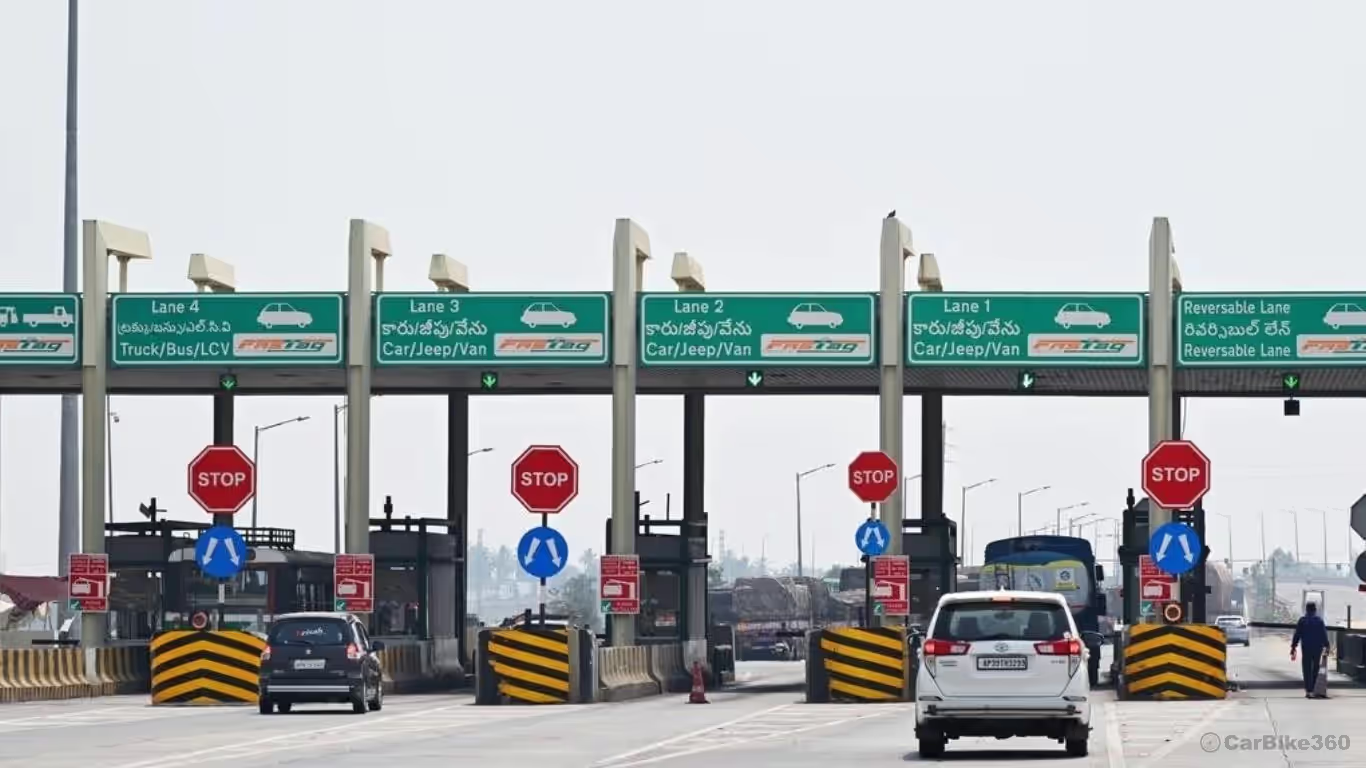
MLFF is a toll collection system that allows vehicles to pass through toll points without stopping at barriers. Using a combination of cameras, sensors, GPS, and RFID technology (FASTag), the system automatically identifies vehicles and deducts toll electronically. This eliminates the bottlenecks at traditional toll plazas, reducing congestion and improving highway efficiency.
Unlike the current FASTag-based system where vehicles still slow down at dedicated lanes, MLFF allows free-flow traffic at normal highway speeds, with toll being deducted seamlessly in the background.
The E-Notice System: How It Works
The most significant aspect of the new rules is the structured process for recovering unpaid tolls:
- Automated Detection: Electronic toll infrastructure (cameras, ANPR, RFID readers) records the vehicle’s passage
- VAHAN Integration: The NETC (National Electronic Toll Collection) system cross-references the vehicle with the VAHAN database for owner identification
- E-Notice Issuance: An electronic notice is sent within 72 hours via SMS, email, or mobile app, specifying vehicle details, date, location, and amount payable
- 72-Hour Payment Window: If the toll is paid within 72 hours, only the original amount is due
- Penalty for Non-Payment: If unpaid after the window, the fee becomes twice the standard toll amount
Constitutional Framework
Article 14 — Right to Equality (Non-Arbitrariness): The e-notice system must comply with Article 14’s requirement that state action be non-arbitrary. In E.P. Royappa v State of Tamil Nadu (1974), the Supreme Court held that “equality is antithetical to arbitrariness.” The structured penalty framework with clear timelines and grievance redressal mechanisms is designed to meet this standard.
Article 19(1)(d) — Freedom of Movement: All citizens have the right to move freely throughout India. However, this right is subject to reasonable restrictions under Article 19(5) in the interest of the general public. Toll collection on national highways has been upheld as a reasonable restriction — fees fund highway construction, maintenance, and public infrastructure.
Article 21 — Due Process: Following Maneka Gandhi v Union of India (1978), any procedure that restricts personal liberty must be fair, just, and reasonable. The 72-hour notice period, grievance redressal mechanism, and graduated penalty structure collectively ensure due process compliance.
National Highways Act, 1956: Provides for declaration of highways as National Highways and empowers the government to levy and collect fees for use of national highways.
Motor Vehicles (Amendment) Act, 2019: Introduced major reforms including stricter penalties, electronic enforcement mechanisms, and provisions for intelligent transportation systems that enable MLFF.
Consequences of Non-Payment
The new rules tie toll compliance to critical vehicle administration processes, creating powerful enforcement mechanisms:
- NOC (No Objection Certificate): Vehicle owners cannot obtain an NOC — required for selling or transferring a vehicle — unless all unpaid toll dues are settled
- Fitness Certificate: Renewal is contingent on clearing dues, ensuring compliance before a vehicle can be certified roadworthy
- National Permits: Pending toll dues can block issuance of national permits for commercial vehicles
- Form 28: The official NOC application now requires disclosure of any pending unpaid toll demands
Grievance Redressal Mechanism
The rules include a built-in grievance mechanism — a critical component for administrative law compliance. Vehicle owners or drivers who receive an e-notice may submit a representation through the designated portal within 72 hours. This ensures the principles of natural justice (audi alteram partem — hear the other side) are upheld, preventing arbitrary penalties.
CLAT Angle
This topic spans multiple CLAT-relevant legal domains:
- Administrative Law: Principles of natural justice, due process in penalty proceedings, delegated legislation (rules made under parent Acts)
- Constitutional Law: Article 14 (non-arbitrariness), Article 19(1)(d) (freedom of movement) vs reasonable restrictions, Article 21 (due process)
- Digital Governance: E-governance reforms, VAHAN/NETC integration, electronic service of notice — validity and legal standing
- Statutory Interpretation: Relationship between National Highways Act 1956, MV Amendment Act 2019, and subordinate rules
- Comparative Questions: How do digital toll systems balance efficiency with fundamental rights? Can linking toll compliance to NOC/fitness certificates be challenged as excessive?
Key Facts at a Glance
| MLFF | Multi-Lane Free Flow tolling (no barriers) |
| Rules Effective | March 17, 2026 |
| E-Notice Window | 72 hours to pay at original rate |
| Penalty | 2x standard toll after 72-hour window |
| VAHAN Integration | NETC linked with vehicle registration database |
| NOC Blocking | No vehicle transfer without clearing toll dues |
| National Highways Act | 1956 (parent legislation) |
| MV Amendment Act | 2019 (electronic enforcement basis) |
Mnemonic: “DRIVE” for New Toll Framework
D — Digital enforcement (MLFF, ANPR cameras)
R — Recovery via e-notice (72-hour window)
I — Integration with VAHAN database
V — Vehicle services blocked (NOC, fitness, permits)
E — Escalation: 2x penalty after deadline
The NHAI toll reforms represent a paradigm shift in India’s highway governance — from manual, barrier-based collection to a fully digital, enforcement-driven system. For CLAT 2027 aspirants, this provides excellent material for administrative law questions involving due process, delegated legislation, digital governance, and the balance between state regulation and individual rights.
Practice Quiz — 10 CLAT-Style Questions
Click an option to reveal the answer and explanation.