
CURRENT AFFAIRS | 28 APRIL 2026
CLAT GK + CONSTITUTIONAL LAW & RELEVANT AREA
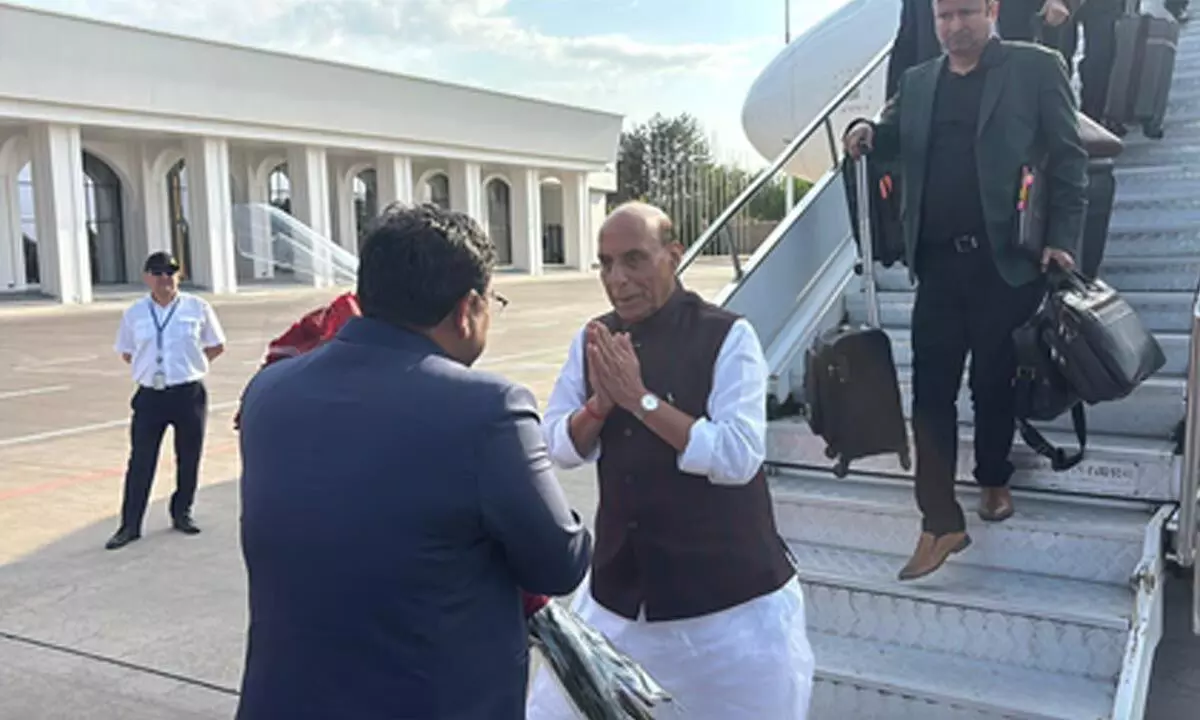
Defence Minister Rajnath Singh arrived in Bishkek, Kyrgyzstan, on 27 April 2026 to lead the Indian delegation at the Shanghai Cooperation Organisation (SCO) Defence Ministers’ Meeting on 28 April 2026. The meeting brings together defence ministers of all SCO members — India, China, Russia, Kazakhstan, Kyrgyzstan, Pakistan, Tajikistan, Uzbekistan, Iran and Belarus — to deliberate on regional security, counter-terrorism, and defence cooperation.
India arrives at the table with two emphatic messages. First, “zero tolerance for terrorism and extremism” — pointed counter-Pakistan signalling within the SCO platform after Operation Sindoor. Second, India’s commitment to global peace amid the West Asia energy crisis. The meeting is the lead-up to the SCO Council of Heads of State summit later in 2026.
⚖️ Constitutional & Legal Framework
- Article 51 (DPSP) — State shall endeavour to (a) promote international peace and security, (b) maintain just and honourable relations between nations, (c) foster respect for international law and treaty obligations, (d) encourage settlement of international disputes by arbitration.
- Article 253 — Parliament’s exclusive power to legislate for treaty implementation.
- Article 73 + Entry 14, List I — Union’s executive treaty-making power.
- SCO Charter, 7 June 2002 (St. Petersburg) — founding instrument; objectives include strengthening mutual confidence and good-neighbourliness.
- RATS — Regional Anti-Terrorist Structure, headquartered in Tashkent, Uzbekistan; permanent SCO body for counter-terror coordination.
- India joined SCO in 2017 at Astana Summit, alongside Pakistan; Iran joined 2023; Belarus 2024.
- Astana Declaration 2024 — reaffirmed SCO’s stand against terrorism, separatism and extremism (the “three evils”).
- UN Charter Article 51 — inherent right of self-defence (often confused with Indian Constitution’s Article 51 — both relevant to the SCO terror discourse).
📚 Why This Matters for CLAT 2027
This is an International Relations + Polity (DPSP) dual-pillar topic that CLAT loves. Memorise the SCO 10-member list in the order of accession: founding six (China, Russia, Kazakhstan, Kyrgyzstan, Tajikistan, Uzbekistan in 2001) → India + Pakistan (2017) → Iran (2023) → Belarus (2024).
Cross-cut tests: contrast SCO with BIMSTEC (Bay of Bengal grouping that excludes China and Pakistan) and with the Quad (Indo-Pacific, excludes China). The “three evils” doctrine — terrorism, separatism, extremism — is the SCO’s signature counter-terror frame, distinct from the UN’s standard formulations. Pair with Article 51 DPSP and the Maganbhai Patel treaty-making line of cases.
📊 Key Facts at a Glance
| Feature | Detail |
|---|---|
| Meeting date | 28 April 2026 |
| Venue | Bishkek, Kyrgyzstan |
| India’s delegation lead | Rajnath Singh, Defence Minister |
| SCO Charter signed | 7 June 2002, St Petersburg |
| SCO members (2026) | 10 (India, China, Russia, Pakistan, Iran, Belarus + 4 Central Asia) |
| India’s induction | 2017 (Astana Summit), with Pakistan |
| Iran inducted | 2023 |
| Belarus inducted | 2024 |
| RATS HQ | Tashkent, Uzbekistan |
| “Three evils” doctrine | Terrorism, Separatism, Extremism |
| Constitutional anchor | Art 51 DPSP + Art 253 |
🧠 Memory Hook
“CHINA-RUSSIA, FOUR-STANS, INDIA-PAK, IRAN-BELARUS — TEN AT BISHKEK”
2001 — Six founders (CN, RU, KZ, KG, TJ, UZ) · 2017 — India + Pakistan (Astana) · 2023 — Iran · 2024 — Belarus · RATS in Tashkent · Three Evils: T-S-E
The Bishkek meeting illustrates the geopolitical contradictions India navigates inside the SCO — sharing a table with both Pakistan and China while pushing a counter-terror frame. The forum’s value to India lies in Central Asian connectivity, energy security, and the legitimacy of a non-Western multilateral counter-terror voice.
For CLAT, anchor any SCO-related answer in Article 51 DPSP (international peace) and the SCO Charter 2002. A Legal Reasoning passage testing whether RATS-issued counter-terror notices bind Indian municipal courts would route through Article 253 — and the answer is “no, until Parliament legislates”.
Practice Quiz — 10 CLAT-Style Questions
Click an option to reveal the answer and explanation.