
CURRENT AFFAIRS | MAY 6, 2026
CLAT GK + ENVIRONMENT & ECOLOGY
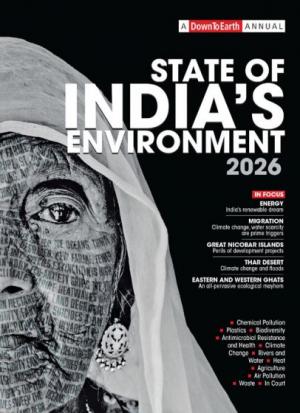
The Centre for Science and Environment (CSE) — publishers of the renowned Down To Earth magazine — released their annual State of India’s Environment 2026 report at the Anil Agarwal Dialogue 2026. The report delivers a stark warning: Earth’s life-support systems are collapsing, and India is among the most exposed nations to ecological breakdown. For CLAT 2027 aspirants, this report is a goldmine — it touches constitutional provisions, landmark cases, international treaties, and static GK all at once.
The Planetary Boundaries Framework
Developed by the Stockholm Resilience Centre, the concept of “planetary boundaries” defines 9 “safe operating spaces” for humanity — natural systems whose stability is essential for human civilisation to survive. Cross these boundaries and we risk triggering irreversible, catastrophic changes to Earth’s systems.
As of 2026, 7 of the 9 boundaries have been breached.
Constitutional Framework: Environment in the Indian Constitution
Article 48A (DPSP): “The State shall endeavour to protect and improve the environment and to safeguard the forests and wild life of the country.” Added by the 42nd Constitutional Amendment, 1976.
Article 51A(g) (Fundamental Duty): “It shall be the duty of every citizen of India to protect and improve the natural environment including forests, lakes, rivers and wild life, and to have compassion for living creatures.” Also added by the 42nd Amendment, 1976.
Key environmental legislation: Environment Protection Act 1986 (umbrella legislation) · Water (Prevention and Control of Pollution) Act 1974 · Air (Prevention and Control of Pollution) Act 1981 · Wildlife Protection Act 1972 (amended 2022) · Forest Conservation Act 1980 · Biological Diversity Act 2002 · National Green Tribunal Act 2010
National Green Tribunal (NGT): Established 2010; headquartered in New Delhi; first specialised environmental court in Asia; hears civil cases on environment, forests, and natural resources.
The 7 Breached and 2 Safe Boundaries
BREACHED (7) — Remember with “BCFLON-7”:
- Biosphere integrity (biodiversity loss) — extinction rate 100+ per million species-years vs safe limit of 10
- Climate change — atmospheric CO2 well above 350 ppm safe limit
- Freshwater change — blue and green water cycles disrupted
- Land-system change — deforestation and agricultural conversion
- Ocean acidification — surface acidity up 30-40% since industrial era (newly confirmed breached in 2026)
- Novel entities — chemical pollution, plastics, nuclear waste
- Biogeochemical flows — nitrogen and phosphorus cycle disruption from fertilisers
SAFE (2) — “OSafe”: Stratospheric Ozone Depletion (recovering since Montreal Protocol 1987) · Atmospheric Aerosol Loading (still within limits)
CLAT Angle: Landmark Environmental Cases
MC Mehta v Union of India (1987): Ganga pollution case — Supreme Court ordered industries discharging into Ganga to stop; established absolute liability for industries causing environmental damage; also led to CNG mandate for Delhi buses.
Vellore Citizens’ Welfare Forum v Union of India (1996): The most important environmental case for CLAT — formally adopted the Precautionary Principle (if in doubt, don’t pollute) and the Polluter Pays Principle into Indian law.
Indian Council for Enviro-Legal Action v Union of India (1996): Established that industries must bear the full cost of environmental remediation.
T.N. Godavarman Thirumulpad v Union of India (ongoing since 1995): The “forests case” — Supreme Court acts as continuous environmental guardian over India’s forests.
India-Specific Findings from CSE 2026
- Extreme weather events occurred on 99% of days in 2025 (up from 87% in 2023)
- 4,419 people died from extreme weather events in 2025
- India’s forest cover: 25.17% of total geographical area — well short of the 33% target under National Forest Policy 1988
- 7 of India’s 10 most polluted cities globally are in India (IQAir 2025 data)
- India has 98 Ramsar wetland sites — highest in Asia (grew from 26 in 2014)
Key Facts Table for CLAT Revision
| Fact | Detail |
| Planetary Boundaries Breached | 7 of 9 (as of 2026) |
| Extreme weather days in India (2025) | 99% of all days |
| Deaths from extreme weather (2025) | 4,419 |
| India forest cover | 25.17% (target: 33%) |
| Ramsar sites in India (2026) | 98 (highest in Asia) |
| NGT established | 2010 (first in Asia) |
| Article 48A added by | 42nd Amendment 1976 |
| Montreal Protocol (ozone) | 1987 |
| Paris Agreement Net Zero (India) | 2070 |
| CSE founded | 1980 |
| Kunming-Montreal Framework (30×30) | CBD COP15, 2022 |
International Commitments
Paris Agreement (2015): India ratified in 2016; target Net Zero emissions by 2070; India’s NDC targets 50% non-fossil fuel electricity by 2030.
Kunming-Montreal Global Biodiversity Framework (CBD COP15, 2022): The “30×30” target — protect 30% of land and oceans by 2030. India committed.
Montreal Protocol (1987): Phases out ozone-depleting substances (CFCs, HCFCs). The stratospheric ozone layer is now recovering — the one planetary boundary coming back from the brink.
Memory Mnemonic
“BCFLON-7” for the 7 breached planetary boundaries: Biosphere · Climate · Freshwater · Land system · Ocean acidification · Novel entities · (Nitrogen) Biogeochemical flows
“OSafe” — Ozone and aerosol loading are Still Safe (recovering since Montreal Protocol)
42A = 48A + 51A(g) — Both the environment DPSP and Fundamental Duty were added by the 42nd Amendment 1976.
Test Your Knowledge: CSE Environment 2026 MCQs
Practice Quiz — 10 CLAT-Style Questions
Click an option to reveal the answer and explanation.