
CURRENT AFFAIRS | 17 APRIL 2026
CLAT GK + CONSTITUTIONAL LAW & RELEVANT AREA
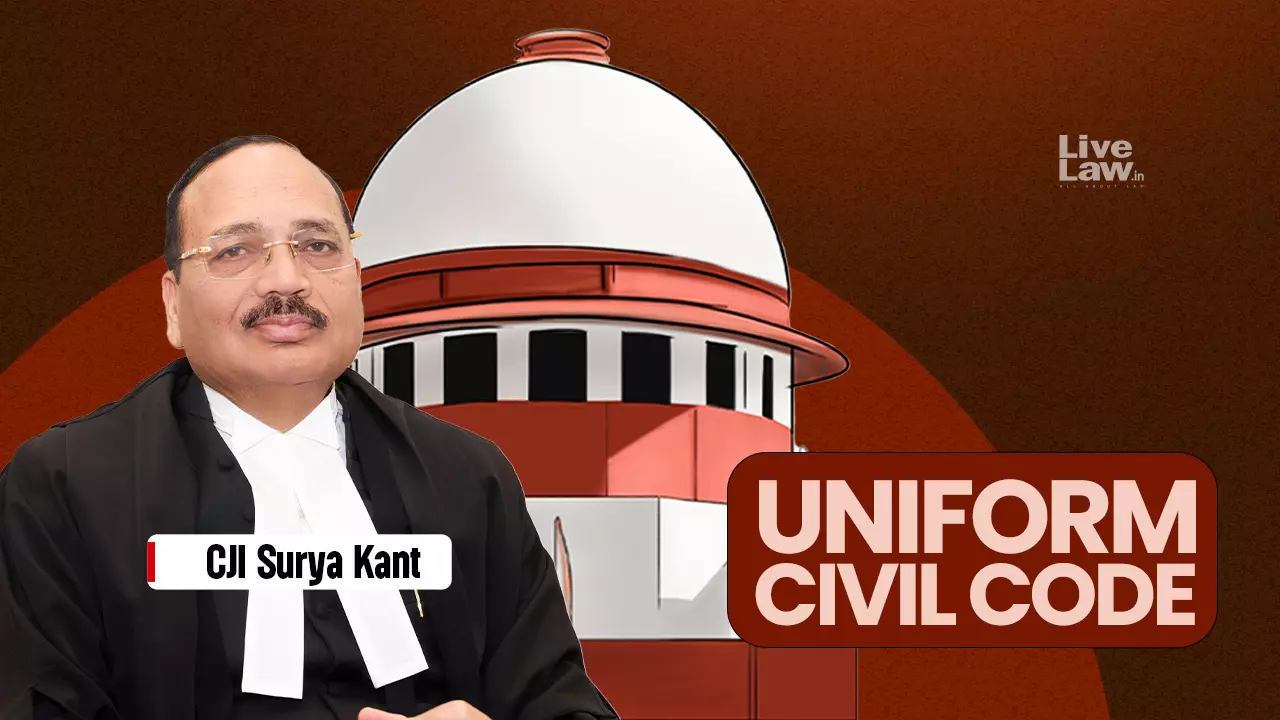
A 3-judge Supreme Court bench led by Chief Justice of India Surya Kant, with Justices Joymalya Bagchi and Vipul M. Pancholi, has held that the Uniform Civil Code is a “constitutional ambition” under Article 44 and has “nothing to do with any religion”. The bench was hearing a writ petition under Article 32 challenging provisions of the Muslim Personal Law (Shariat) Application Act, 1937 relating to inheritance and testamentary succession as discriminatory against women. CJI Kant observed that UCC must be uniform across religions; Justice Bagchi remarked that inheritance is “definitely not an essential religious practice”. This is the first explicit framing by the Supreme Court of UCC as a constitutional (not communal) project since Sarla Mudgal (1995) and anchors the debate in Article 44 and the Special Marriage Act, 1954 — treating codification as distinct from imposition.
Constitutional Framework
Article 44 is a Directive Principle of State Policy: “The State shall endeavour to secure for the citizens a uniform civil code throughout the territory of India.” Being part of Part IV, it is non-justiciable — courts cannot force the State to enact it, but the State is duty-bound to work towards it.
On the other side stand Articles 25 and 26 (FR): freedom of conscience, free profession, practice and propagation of religion, and the right to manage religious affairs. The apparent clash is reconciled through the Essential Religious Practices (ERP) doctrine first laid down in Shirur Mutt (1954) — only practices essential to a religion attract Art 25-26 protection. In Minerva Mills v UoI (1980), the Supreme Court held that harmony between Part III (FR) and Part IV (DPSP) is itself a basic-structure feature, meaning DPSPs can serve as interpretive aids to FRs.
The Special Marriage Act, 1954 already operates as a secular, religion-neutral civil-marriage law — a pre-existing UCC template. In 2024, Uttarakhand became the first State to enact an operational UCC (excluding Scheduled Tribes in recognition of customary tribal law under Art 342 and the Sixth Schedule).
CLAT Angle / Why This Matters
This is the cleanest framing of UCC since 1995, and CLAT 2027 passage-setters will notice. The CJI’s line — “UCC has nothing to do with religion” — neatly separates the aspirational project (codification of personal law) from the political framing (majoritarian imposition). Expect CLAT passages that test:
- DPSP vs FR hierarchy: Can a DPSP override an FR? (Answer: No, not directly — but DPSPs aid interpretation of FRs per Minerva Mills.)
- The Shah Bano / Sarla Mudgal / Shayara Bano trilogy — three SC moments where Muslim personal law intersected with constitutional values.
- The Essential Religious Practices test — is inheritance an “essential” practice? (Justice Bagchi thinks not.)
- The distinction between uniformity and uniform imposition of one community’s law.
Watch for the trap option: “DPSPs are superior to FRs after Minerva Mills.” That is false. FRs remain enforceable; DPSPs guide interpretation.
Key Facts at a Glance
| Item | Detail |
|---|---|
| Bench | CJI Surya Kant, Justices Bagchi and Pancholi |
| Statute challenged | Muslim Personal Law (Shariat) Application Act, 1937 |
| Constitutional anchor | Article 44 (DPSP); Articles 25-26 (FR) |
| Key case trilogy | Shah Bano (1985), Sarla Mudgal (1995), Shayara Bano (2017) |
| ERP doctrine source | Commissioner, HRE v LT Swamiar of Shirur Mutt (1954) |
| First operational UCC | Uttarakhand UCC Act 2024 (excludes Scheduled Tribes) |
| Secular marriage law | Special Marriage Act, 1954 |
Mnemonic: AMBITION
Article 44 anchor | Marriage codified (SMA 1954) | Bagchi observation (inheritance not ERP) | Inheritance + Testamentary focus | Inter-religion uniformity | Onus on State | No religion link
Take the Quiz (10 MCQs)
Practice Quiz — 10 CLAT-Style Questions
Click an option to reveal the answer and explanation.
Want more CLAT 2027 current-affairs analysis like this? Explore daily briefings, past-year passage drills and mock-test simulators at CLAT Gurukul — Patna’s most trusted CLAT coaching.