
CURRENT AFFAIRS | MAY 6, 2026
CLAT GK + INTERNATIONAL RELATIONS
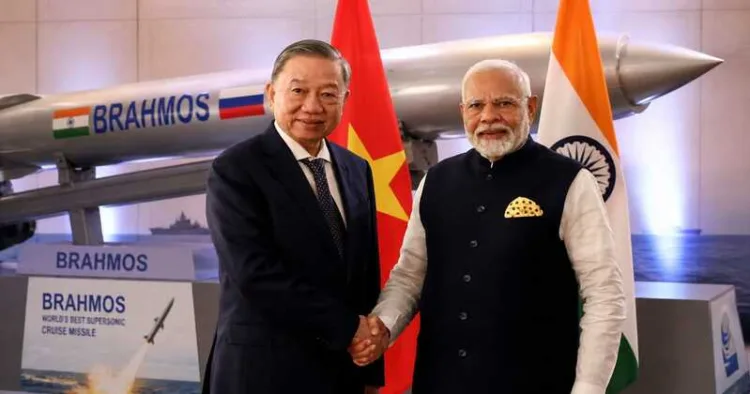
Vietnamese President Luong Cuong is on a 3-day state visit to India (May 5–7, 2026) — the first visit by a Vietnamese head of state in this diplomatic cycle. PM Modi and President Cuong held bilateral talks, releasing a joint statement on deepening the India-Vietnam Comprehensive Strategic Partnership (CSP, established 2016).
The visit comes at a strategically significant moment: both nations share concerns about China’s maritime assertiveness in the South China Sea, and are deepening ties in defence technology, semiconductors, digital connectivity, and trade — with a target of $30 billion bilateral trade by 2030 (from the current ~$15 billion).
Constitutional Framework: India’s Foreign Policy Mandate
Article 51 (DPSP) — Part IV, Directive Principles of State Policy — directs India to endeavour to:
- (a) Promote international peace and security
- (b) Maintain just and honourable relations between nations
- (c) Foster respect for international law and treaty obligations
- (d) Encourage settlement of international disputes by arbitration
This constitutional mandate underpins India’s engagement with Vietnam, ASEAN, and the broader Indo-Pacific framework. India’s support for UNCLOS-based resolution of South China Sea disputes directly reflects Article 51(c) and (d).
Article 253 — Empowers Parliament to legislate on any matter (including State List subjects) to implement international treaties and agreements. This is how India enacts domestic laws to fulfil its UNCLOS, MLC and other international obligations.
Act East Policy: From “Look East” to Strategic Partnership
India’s engagement with Southeast Asia evolved in two phases:
| Feature | Look East Policy (1991) | Act East Policy (2014) |
|---|---|---|
| Launched by | PM P.V. Narasimha Rao | PM Narendra Modi |
| Year | 1991 | 2014 (ASEAN Summit, Myanmar) |
| Primary focus | Trade and economic ties | Strategic: defence + connectivity + culture + trade |
| Geographic scope | ASEAN region | ASEAN + East Asia + Pacific |
| Defence dimension | Minimal | Central — defence exports, joint exercises, tech transfer |
ASEAN: The Essential CLAT Fact Set
The Association of Southeast Asian Nations (ASEAN) is central to India’s Act East Policy.
- Founded: August 8, 1967 (Bangkok Declaration)
- Founding members (5): Indonesia, Malaysia, Philippines, Singapore, Thailand
- Current members (10): + Brunei (1984), Vietnam (1995), Laos (1997), Myanmar (1997), Cambodia (1999)
- Secretariat: Jakarta, Indonesia
- India-ASEAN FTA in Goods: 2010 | Services: 2015 | Investments: 2015
- India-ASEAN Dialogue Partnership: Since 1992; upgraded to Strategic Partnership 2012, then Comprehensive Strategic Partnership 2022
South China Sea: The Strategic Context
The South China Sea is one of the world’s most contested maritime regions. China claims approximately 90% of it through the “Nine-Dash Line” — a claim that overlaps with the EEZs of Vietnam, Philippines, Malaysia, Brunei, and Taiwan.
In 2016, a tribunal constituted under UNCLOS Annex VII (administered by the Permanent Court of Arbitration, PCA, The Hague) ruled in Philippines v China that China’s Nine-Dash Line claim had no basis in international law. China rejected the ruling.
India’s position: India does not take sides on sovereignty claims but consistently calls for resolution based on UNCLOS. India has significant stakes — it imports ~80% of its oil needs, much of which transits the South China Sea or the Strait of Hormuz.
Key disputed features: Paracel Islands (occupied by China, claimed by Vietnam) and Spratly Islands (claimed by China, Vietnam, Philippines, Malaysia, Brunei, Taiwan).
CLAT Angle: India-Vietnam Defence & Semiconductor Partnership
Defence exports: India gifted Vietnam INS Kirpan (a warship) — reflecting India’s defence export push under the Act East Policy. BrahMos missile discussions ongoing.
Semiconductors: Vietnam has emerged as a key global semiconductor manufacturing hub. India-Vietnam semiconductor supply chain linkage is a strategic priority as both nations seek to reduce dependence on Chinese supply chains.
India’s Iran connection: India’s MEA, during the visit week, addressed the Iran drone strike injuring 3 Indians at Fujairah Petroleum Industries Zone — underscoring how West Asia conflict intersects with India’s oil security and maritime interests (Strait of Hormuz).
CLAT passage tip: Comprehension passages on India’s foreign policy often test whether students can distinguish between DPSP (non-justiciable, policy directions) and Fundamental Rights (justiciable, enforceable). Art. 51 is a DPSP — it guides foreign policy but cannot be enforced in courts by individuals.
Key Facts at a Glance
| Visit dates | May 5–7, 2026 (3-day state visit) |
| India-Vietnam CSP | Established 2016; diplomatic relations since 1972 |
| Trade target | $30 billion by 2030 (current ~$15 billion) |
| ASEAN members | 10; Vietnam joined 1995 |
| Act East Policy | Launched 2014 by PM Modi; evolved from Look East (1991) |
| South China Sea PCA ruling | 2016 — Nine-Dash Line has no basis in international law |
| Quad members | India, USA, Japan, Australia |
| Article 51 (DPSP) | India shall promote international peace + foster international law |
Memory Mnemonic: VAST ACT
Vietnam — CSP 2016; defence + semiconductors + trade
ASEAN — 10 members; Jakarta secretariat; India-ASEAN FTA 2010
South China Sea — Nine-Dash Line rejected by PCA 2016
Trade — $30bn target by 2030
Act East — 2014 (replaced Look East 1991)
Connectivity + defence tech transfer
Treaty power — Art. 253 (Parliament can implement treaties even on State List)
Practice Quiz: Act East Policy, ASEAN & South China Sea
Practice Quiz — 10 CLAT-Style Questions
Click an option to reveal the answer and explanation.