
CURRENT AFFAIRS | 23 APRIL 2026
Why This Matters for CLAT 2027
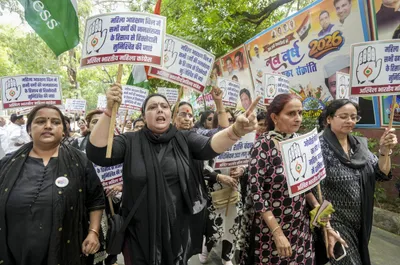
The women’s reservation debate returned to Parliament this April with the Constitution (131st Amendment) Bill, 2026, the Delimitation Bill, 2026, and the Union Territories Laws (Amendment) Bill, 2026 — a legislative triptych designed to operationalise the 33% women’s quota promised by the Nari Shakti Vandan Adhiniyam (106th Amendment Act, 2023). The politics got sharper on 22 April when PM Modi accused the Opposition of being “mahila virodhi” for voting against the package. But as Liz Mathew noted, the BJP faces its own internal numbers problem — the 2007 Sushma Swaraj Committee had recommended 33% women in party organisational bodies, yet only 9% of the national executive are women today.
The News Trigger
On 17 April 2026, the Constitution (One Hundred and Thirty-First Amendment) Bill failed to clear the Article 368 special-majority test in the Lok Sabha. The Bill sought to expand the Lok Sabha to 850 seats, enable fresh delimitation based on the latest available Census, and operationalise the women’s quota in the 2029 general election. While it received more “Aye” than “No” votes, the 2/3rd threshold was not met. The BJP simultaneously launched a UP public campaign and a special parliamentary session on 30 April to revive the push.
Constitutional Framework
- Article 15(3) — enables the State to make special provisions for women and children; an exception to Art 15(1) non-discrimination.
- Articles 243D(3) & 243T(3) — inserted by the 73rd and 74th Amendments (1992), reserve one-third of seats for women in PRIs and ULBs.
- 106th Amendment (2023) — Nari Shakti Vandan Adhiniyam: inserts Art 330A and 332A reserving 33% Lok Sabha and State Assembly seats for women. Implementation contingent on Census + delimitation.
- 131st Amendment Bill (2026) — enlarges Lok Sabha to 850, removes delimitation freeze to unlock immediate rollout.
- Article 368 — since the Amendment affects federal representation, it requires special majority PLUS ratification by at least half the state legislatures.
Landmark Judicial Markers
Indra Sawhney v Union of India (1992) — the Mandal case fixed a 50% ceiling on total reservations, subject only to extraordinary circumstances. A horizontal 33% women’s reservation overlaps vertical SC/ST/OBC quotas and must respect this ceiling.
M Nagaraj v Union of India (2006) — upheld the 77th, 81st, 82nd and 85th Amendments on SC/ST promotions, subject to creamy-layer test, backwardness data and administrative efficiency. The ‘twin tests’ of backwardness and inadequate representation may attract debate if horizontal women’s reservation is challenged.
Government of NCT of Delhi v Union of India (2018) — emphasised constitutional federalism; Article 368 ratification becomes vital when the amendment touches representation.
CLAT Angle
Expect passage-based principle-application questions on: (a) difference between vertical (Art 16(4)) and horizontal (Art 15(3)) reservation; (b) Art 368 ratification mechanics; (c) delimitation freeze under Art 82 and 170; (d) how “creamy layer” reasoning from Nagaraj interacts with gender-based reservation; (e) basic structure review of parliamentary composition changes.
Key Facts at a Glance
| Milestone | Detail |
|---|---|
| First attempt | Women’s Reservation Bill 1996 under PM Deve Gowda — lapsed |
| 73rd/74th Amendments | 1992 — one-third reservation in PRIs and ULBs |
| Sushma Swaraj Committee | 2007 — recommended 33% women in BJP organisational set-up |
| 106th Amendment | 2023 — Nari Shakti Vandan Adhiniyam passed; awaits delimitation |
| 131st Amendment Bill | 2026 — defeated in Lok Sabha on 17 April; BJP re-launch 30 April |
| BJP national executive women | ~9% (against self-imposed 33% goal of 2007) |
Mnemonic: “106 plus 131 equals 2029”
106 gave the right (Nari Shakti Vandan, 2023). 131 seeks the route (delimitation + larger Lok Sabha). Add them and you get the target election — 2029. Remember the four checkpoints: Census → Delimitation → Seat expansion → Rollout.
The Internal BJP Gap — Why Numbers Matter
The Indian Express piece sharpens the irony: a party that preaches 33% and accuses the Opposition of “mahila virodhi” had its own 2007 Sushma Swaraj Committee report recommending identical 33% representation in its organisational set-up. Nearly two decades later, women make up roughly 9% of the national executive and only a handful hold decisive office. For CLAT, this is a clean illustration of why political will and formal legal reservation are different variables.
What to Watch Next
- BJP’s 30 April special session — does the government introduce a diluted version or hold firm on 850 seats?
- South India pushback — will Tamil Nadu and Kerala move the Supreme Court on federalism grounds under Article 131?
- The Delimitation Bill 2026 — Commission headed by SC judge; orders final and binding (a non-justiciability puzzle).
Practice Quiz — 10 CLAT-Style Questions
Click an option to reveal the answer and explanation.