
CURRENT AFFAIRS | 23 APRIL 2026
The News Trigger
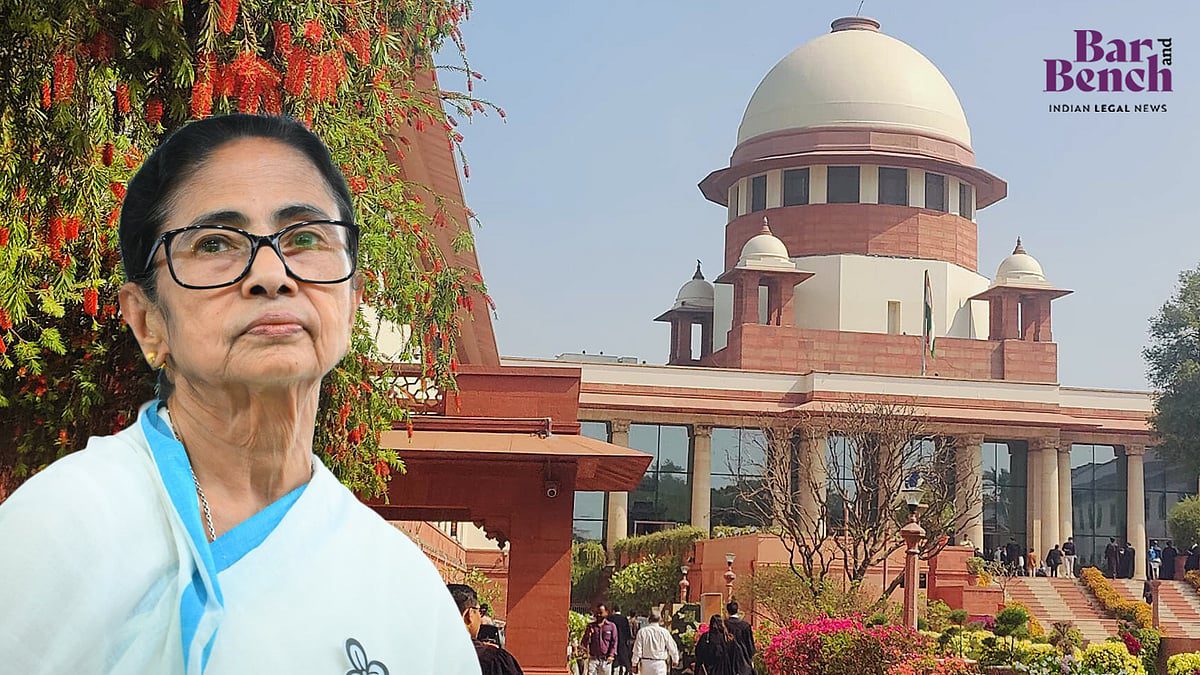
On 22 April 2026, a Supreme Court bench of Justices Prashant Kumar Mishra and N.V. Anjaria orally remarked that the alleged interference by West Bengal CM Mamata Banerjee during an Enforcement Directorate search on the Kolkata office of political-consultancy firm I-PAC “put democracy in peril.” The Court was hearing petitions filed by the ED seeking registration of a CBI FIR against Banerjee and senior state police officials over obstruction of the 8 January 2026 search. The Bench is considering whether to refer the WB Government’s counter-suit under Article 131 to a five-judge Constitution Bench.
What Exactly Happened
The ED raided I-PAC premises in January 2026 in connection with a money-laundering probe. Around the same time, it raided the Kolkata deputy commissioner (Special Branch) and arrested Shantanu Sinha Biswas along with businessman Joy Kamdar in a connected land-grab case. When ED officers were gheraoed by protestors during the raid — allegedly in the CM’s presence — judicial officers supervising the process were reportedly obstructed. West Bengal retaliated by filing an Article 131 suit against the Centre, alleging federal overreach.
Constitutional Framework
- Article 32 — fundamental right to move the SC for enforcement of Part III rights; cannot be suspended except under Art 359.
- Article 131 — exclusive original jurisdiction of the SC in disputes between Centre–State or between States.
- Article 142 — power to pass decrees for complete justice in any pending matter.
- Article 145(3) — Constitution Bench of at least 5 judges for substantial questions of constitutional interpretation.
- Article 50 — Directive Principle: separation of judiciary from executive.
- PMLA 2002 — source statute for ED’s investigative powers in money-laundering offences.
Landmark Judicial Markers
State of West Bengal v Union of India (1963) — established that Indian federalism is not absolute; Parliament can acquire State property. Set the frame for Article 131’s scope.
State of Jharkhand v State of Bihar (2015) — clarified Article 131 maintainability; a State may directly sue under Art 131 only for legal, not merely political, rights.
Indira Nehru Gandhi v Raj Narain (1975) — recognised judicial independence as part of the basic structure.
Vijay Madanlal Choudhary v UoI (2022) — upheld ED’s core powers under PMLA.
CLAT Angle
High-probability principle-application themes: (a) when an individual act by a constitutional functionary ceases to be a “State act” for Art 131 purposes; (b) Art 32 vs Art 131 — the Bench’s observation that “when a CM walks into an ED inquiry, it’s not a Centre–State dispute”; (c) contempt of court jurisdiction for obstructing judicial officers; (d) federalism as basic structure; (e) ED powers under PMLA post-Vijay Madanlal.
Key Facts at a Glance
| Element | Detail |
|---|---|
| Raid date | 8 January 2026 — I-PAC Kolkata office |
| SC hearing | 22 April 2026 — Justices Mishra & Anjaria |
| Statute for ED | PMLA 2002 |
| WB Counter-suit | Article 131 original jurisdiction |
| Constitution Bench size | At least 5 (Art 145(3)) |
| I-PAC | Private political-consulting firm (founded by Prashant Kishor) |
Mnemonic: “32-131-142-145(3)”
The four Article pins of this case. 32 (individual rights) → 131 (Centre-State) → 142 (complete justice) → 145(3) (Constitution Bench). Walk the ladder and you have the full procedural arc.
The Real Jurisprudential Question
Is a CM’s personal appearance at a raid an act of the State for Article 131 purposes, or is it an individual act liable to contempt and criminal obstruction? The Court’s oral remark — “this is per se an act committed by an individual who happens to be the Chief Minister” — signals it may refuse to let the Article 131 umbrella shield what it sees as interference in judicial process.
Practice Quiz — 10 CLAT-Style Questions
Click an option to reveal the answer and explanation.