
CURRENT AFFAIRS | 31 MARCH 2026
CLAT GK + CONSTITUTIONAL LAW & WOMEN’S RESERVATION
– Constitutional Amendment procedure (Article 368)
– Women’s political representation and reservation framework
– Articles 330, 332, 243D, 243T — reservation in legislatures and local bodies
– 73rd and 74th Constitutional Amendments (1992)
– Timeline of women’s reservation bill (1996-2023)
What Is the Nari Shakti Vandan Adhiniyam?
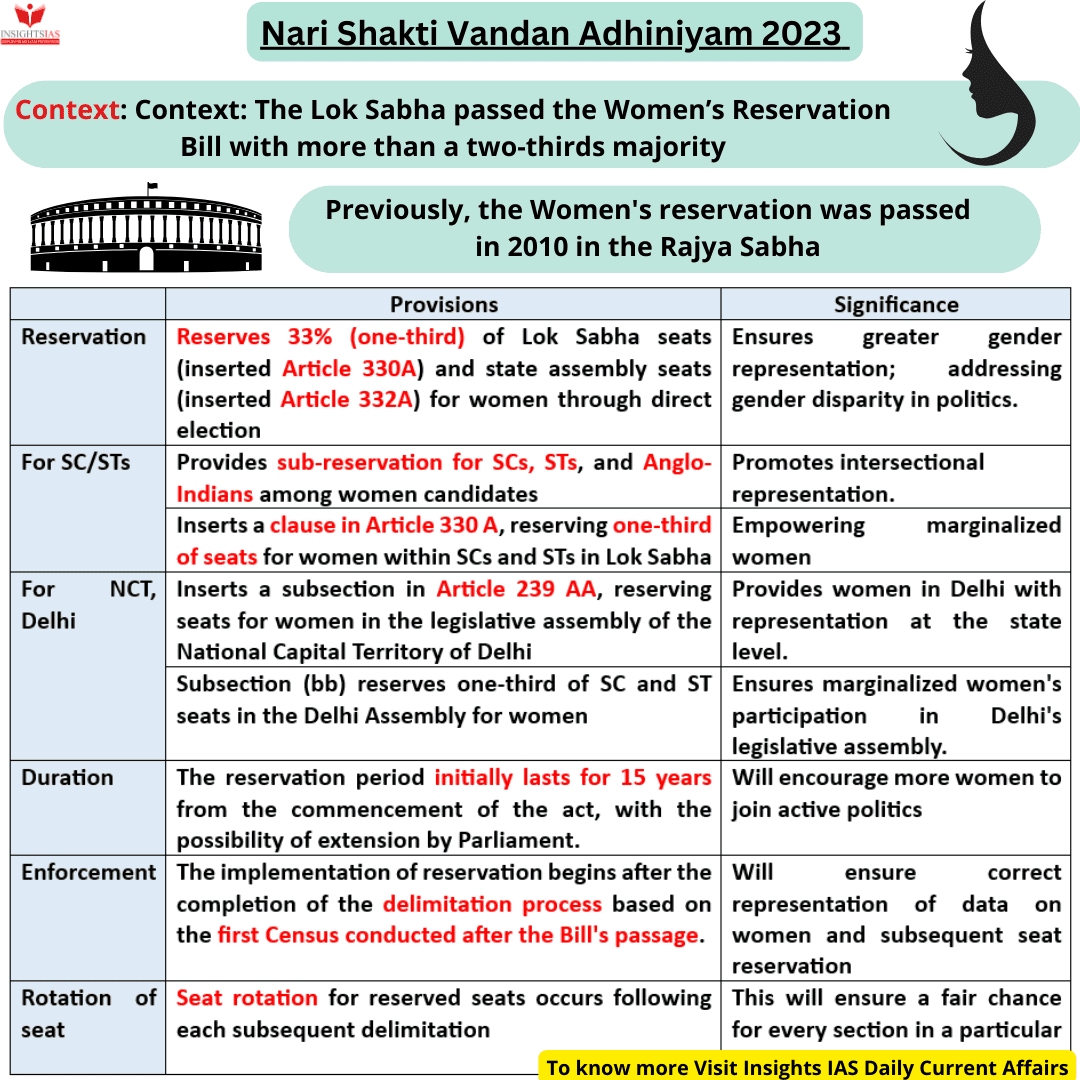
The Constitution (106th Amendment) Act, 2023, popularly known as the Nari Shakti Vandan Adhiniyam, reserves 33% of seats in the Lok Sabha, State Legislative Assemblies, and the Delhi Assembly for women. The Act was passed by the Lok Sabha on 20 September 2023 with 454 votes in favour and only 2 against, and by the Rajya Sabha on 21 September 2023 unanimously with 214 votes. President Droupadi Murmu gave assent on 28 September 2023.
This was the first legislation passed in the new Parliament building, marking a historic milestone. However, its implementation remains linked to the Census and subsequent delimitation exercise — neither of which has been completed yet.
The 30-Year Legislative Journey (1996-2023)
| Year | Event |
| 1996 | First introduced as 81st Amendment Bill (H.D. Deve Gowda govt) |
| 1998, 1999 | Re-introduced but lapsed |
| 2008 | Introduced as 108th Amendment Bill |
| 2010 | Rajya Sabha passed (9 March); Lok Sabha never voted — lapsed |
| 2023 | Passed by both Houses as 128th Amendment Bill; became 106th Amendment Act |
Women constitute 52% of India’s voter base but hold only about 15% of parliamentary seats. The bill’s journey spanning nearly three decades reflects the deep political complexities surrounding gender-based reservation in legislatures.
Key Constitutional Provisions
– Article 330 — Reservation of seats for SCs and STs in Lok Sabha
– Article 332 — Reservation of seats for SCs and STs in State Assemblies
– Article 243D — Reservation of seats in Panchayats (33% for women already exists under 73rd Amendment)
– Article 243T — Reservation of seats in Municipalities (33% for women under 74th Amendment)
– Article 368 — Procedure for Constitutional Amendment (special majority required)
– The 106th Amendment inserts Articles 330A and 332A for women’s reservation in Lok Sabha and State Assemblies respectively
Implementation: The Delimitation-Census Deadlock
The Act states that reservation will come into effect only after a Census conducted post-enactment, followed by a delimitation exercise to identify and rotate reserved constituencies. The 2021 Census has been indefinitely delayed, and the government has announced Census 2027. This means the earliest possible implementation could be the 2029 general elections — six years after the Act was passed.
- Delimitation — The process of readjusting territorial boundaries of constituencies based on Census data
- Rotation — Reserved seats will be rotated after every delimitation exercise (approximately every 10 years)
- Duration — The reservation is for 15 years, but Parliament may extend it by law
The 73rd and 74th Amendments: A Proven Model
The 73rd Constitutional Amendment (1992) for Panchayats and the 74th Amendment (1992) for Municipalities already provide 33% reservation for women in local self-government bodies. Many states like Bihar, Uttarakhand, and Rajasthan have gone further, providing 50% reservation for women at the Panchayat level. This local-body model is the foundation upon which the 106th Amendment extends reservation to Parliament and State Assemblies.
Why BJP’s Rethink Matters Now
With Census 2027 and delimitation on the horizon, the political calculus around the Women’s Reservation Act has intensified. The government faces pressure from multiple quarters:
- OBC demand — Opposition parties, including Congress and SP, demand sub-reservation for OBC women within the 33% quota
- Timeline pressure — Without Census completion and delimitation, the Act remains a paper promise
- Electoral significance — With women voters increasingly decisive, implementation becomes both a political imperative and a democratic milestone
– Constitutional Law: Amendment procedure under Art. 368 (special majority + no state ratification needed for this type)
– GK: Timeline of Women’s Reservation Bill (1996, 2008, 2010, 2023) — frequently tested
– Legal Reasoning: Delayed implementation despite passage — the Census-delimitation linkage as a legal condition precedent
– Comparison: Art. 243D/243T (local bodies) vs. Art. 330A/332A (Parliament/Assemblies)
N — Ninety-six (1996) — first introduced
A — Attempt in 2008 (Rajya Sabha) and 2010 (passed RS, lapsed LS)
R — Ratified in 2023 as 106th Amendment
I — Implementation awaits Census + Delimitation
Source: PRS India, DD News, Insights on India — March 2026
Practice Quiz
Test your understanding with these 10 MCQs:
Practice Quiz — 10 CLAT-Style Questions
Click an option to reveal the answer and explanation.