
CURRENT AFFAIRS | 26 APRIL 2026
CLAT GK + CONSTITUTIONAL LAW & RELEVANT AREA
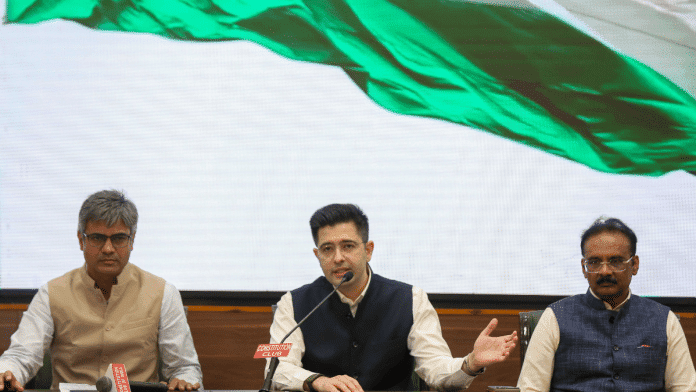
On April 24-25, 2026, the Aam Aadmi Party suffered the largest single-day Rajya Sabha implosion in recent memory. 7 of its 10 sitting RS MPs — Raghav Chadha, Sandeep Pathak, Ashok Mittal, Harbhajan Singh, Vikramjit Sahney, Swati Maliwal and Rajinder Gupta — announced their resignation from AAP and intent to merge with the BJP. The number is not accidental: seven is exactly two-thirds of ten, the precise threshold under Paragraph 4 of the Tenth Schedule to escape disqualification under the Anti-Defection Law. AAP says it will write to the Rajya Sabha Chairman (the Vice-President) and to the Election Commission to test the ‘genuineness’ of the merger.
Why it matters for CLAT: this is a live laboratory for the 91st Amendment, 2003 regime. Until 2003, a one-third ‘split’ exempted defectors from disqualification — that escape hatch was deleted. The only remaining safe harbour is a genuine ‘merger’ under Para 4 requiring (i) two-thirds of the legislature party to agree AND (ii) the original political party to actually merge with another. The doctrinal question that will land in passages and Legal Reasoning sets: does an arithmetic exit by 7-of-10 MPs constitute a ‘merger’ of ‘parties’ — or merely a coordinated defection dressed up as one?
Constitutional & Statutory Framework
- Article 102(2) & Article 191(2) — Members of Parliament and State Legislatures stand disqualified on grounds specified in the Tenth Schedule
- Tenth Schedule, Para 2(1)(a) — disqualification for ‘voluntarily giving up’ party membership
- Tenth Schedule, Para 2(1)(b) — disqualification for voting / abstaining contrary to party whip without prior permission
- Tenth Schedule, Para 4 — ‘merger’ exemption: requires 2/3 of legislature party to agree, AND merger of the original political party
- Tenth Schedule, Para 3 — the ‘split’ exemption (1/3) — DELETED by 91st Amendment, 2003
- Tenth Schedule, Para 6 — Speaker/Chairman is the deciding authority; Para 7 ouster of judicial review was struck down in Kihoto Hollohan
- 52nd Constitutional Amendment, 1985 — inserted the Tenth Schedule (Rajiv Gandhi’s response to defections of the 1960s-70s)
- 91st Constitutional Amendment, 2003 — deleted Para 3 split, capped Council of Ministers at 15% of House strength (Art. 75(1A) / 164(1A))
- Kihoto Hollohan v Zachillhu (1992) — Speaker functions as a ‘Tribunal’; decisions are subject to judicial review on grounds of perversity, mala fide, violation of natural justice
- Ravi S Naik v UoI (1994) — ‘voluntarily giving up’ can be inferred from conduct, not just formal resignation
- Rajendra Singh Rana v Swami Prasad Maurya (2007) — Speaker’s failure to decide is itself reviewable; SC can call for records
CLAT Angle — How This Gets Tested
- Arithmetic doctrine: 7 of 10 = 2/3 floor under Para 4. If even one MP backs out, the merger fails and all 6 face disqualification under Para 2(1)(a) Ravi S Naik.
- Two-stage test under Para 4: (i) two-thirds of the legislature party agree; AND (ii) the original political party (not just MPs) actually merges with another. The second limb is the harder hurdle — AAP as an organisation has not merged with BJP.
- Passage trap: a ‘split’ is no longer a defence. The 91st Amendment 2003 deleted Para 3. Many students still write ‘one-third split’ — that is the post-1985, pre-2003 position and now wrong.
- Speaker timeline: in Keisham Meghachandra Singh (2020) the SC suggested the Speaker should decide disqualification petitions within 3 months; absence of decision is itself reviewable.
- Anti-partisan framing: CLAT does not test which party is right; it tests whether constitutional process was followed. Stay doctrinal.
Key Facts at a Glance
| Total AAP RS MPs (before) | 10 |
| MPs who announced resignation + BJP merger | 7 (Chadha, Pathak, Mittal, Harbhajan Singh, Sahney, Maliwal, Gupta) |
| Tenth Schedule merger threshold (Para 4) | Two-thirds — exactly 7 of 10 here |
| Constitutional articles invoked | Art. 102(2) & Art. 191(2) read with Tenth Schedule |
| Deciding authority for RS defection | Vice-President as ex-officio Chairman of Rajya Sabha |
| ‘Split’ provision (Para 3) status | DELETED by 91st Amendment, 2003 |
| Landmark SC case on judicial review | Kihoto Hollohan v Zachillhu (1992) |
| Conduct-based defection precedent | Ravi S Naik v UoI (1994) |
The doctrinal heart. The Tenth Schedule is a constitutional bargain: free speech inside the House (Art. 105) is traded for party discipline outside it. The 91st Amendment hardened that bargain by killing the ‘split’ loophole. The 7-MP exit is engineered to the exact arithmetic of Para 4 — but the second limb (the parties themselves merging) is far harder to satisfy. AAP’s challenge before the Chairman will turn on whether ‘merger of legislature party’ alone is enough, or whether the parent organisation must merge too. The latter reading — backed by Rajendra Singh Rana and the text of Para 4(2) — is the stronger one. Watch this space; the first big judicial test of the post-91st-Amendment merger doctrine is now squarely on the table.
Mnemonic — 10-52-91-2/3
10th Schedule · 52nd Amendment (1985) inserted it · 91st Amendment (2003) killed the split · 2/3 merger floor · 3 months Speaker timeline (Meghachandra) · cases: Kihoto · Ravi S Naik · Rajendra Singh Rana → mnemonic K-R-R.
Likely exam questions. (1) The Anti-Defection Law is in which Schedule? (2) The merger threshold under Para 4 is what fraction? (3) Which Amendment deleted the ‘split’ provision? (4) Who decides disqualification of a Rajya Sabha member? (5) Legal-reasoning passage — given the two-limb test of Para 4, can a 7-of-10 exit qualify as a merger if the original parties have not merged?
Test Yourself — 10 MCQs
Click each option to reveal the answer and explanation.
Practice Quiz — 10 CLAT-Style Questions
Click an option to reveal the answer and explanation.