
CURRENT AFFAIRS | 26 APRIL 2026
CLAT GK + CONSTITUTIONAL LAW & RELEVANT AREA
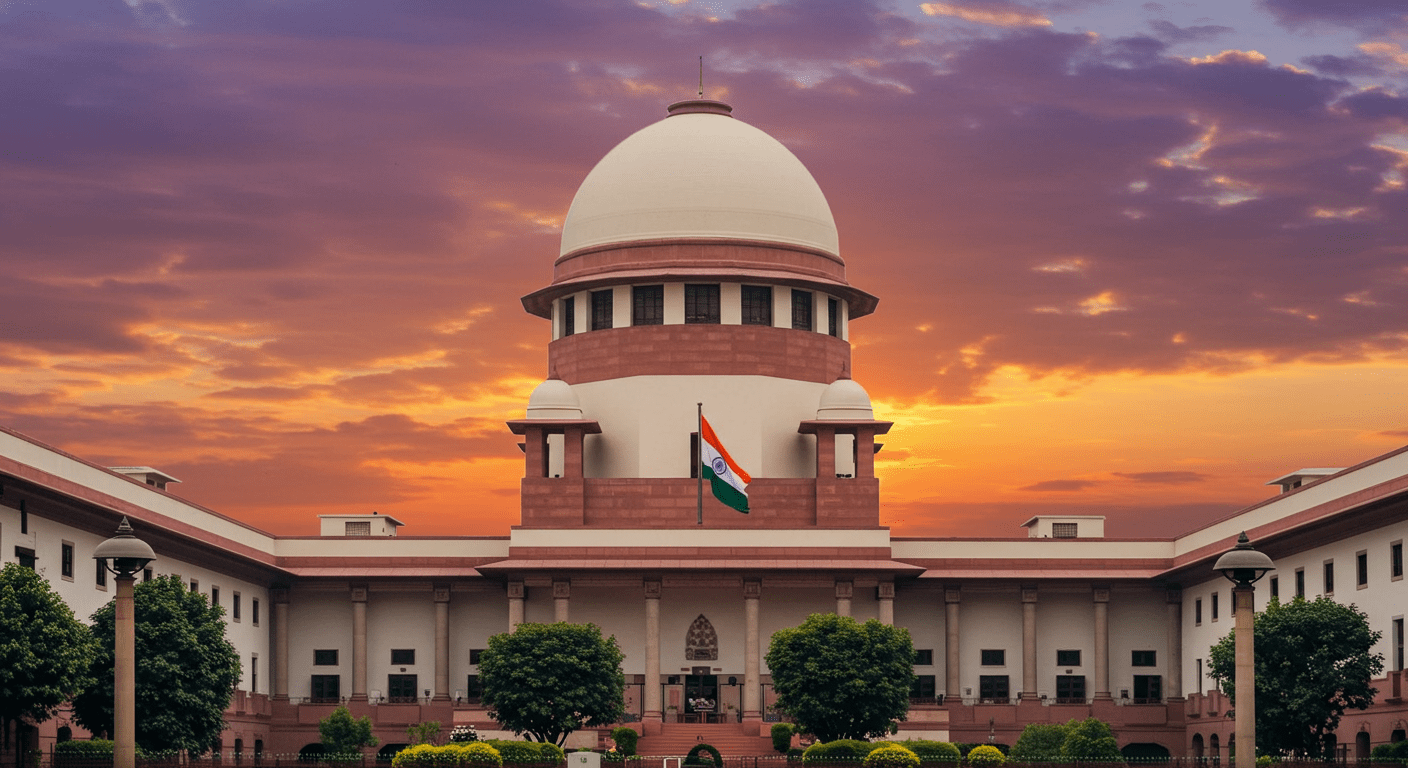
In a landmark April 2026 ruling, the Supreme Court of India invoked its Article 142 ‘complete justice’ powers to issue a 13-point pan-India highway safety directive binding the Centre and all States. The bench was acting on twin tragedies of November 2025 — a Telangana Ranga Reddy bus that crashed into a parked trailer at a roadside dhaba killing 19, and a Rajasthan State Transport bus–lorry collision near Phalodi that killed 19 including a 40-day-old infant. Reading the safety of every commuter as an integral facet of the right to life under Article 21, the Court translated rhetoric into hard timelines: 60-day DM-led demolition of unauthorised structures within the Right of Way, ATMS surveillance on all NHs, GPS-timestamped e-Challans, and a 75-metre prohibition on land-use change from the carriageway.
Why it matters for CLAT: This is a textbook example of judicial law-making under Article 142 in the Vishaka tradition — the Court fills a regulatory vacuum that the executive failed to plug. National Highways are only ~2% of the road network but account for ~30% of fatalities; the Bench framed this as a constitutional emergency, not a policy preference. Expect Legal Reasoning passages pairing Article 21 (Francis Coralie Mullin, Olga Tellis) with Article 142’s residuary equity jurisdiction (Union Carbide, SC Bar Association v UoI).
Constitutional & Statutory Framework
- Article 142(1) — SC may pass any decree/order necessary for doing ‘complete justice’ in any cause or matter pending before it
- Article 21 — right to life and personal liberty; expanded to include right to live with dignity (Maneka Gandhi 1978, Francis Coralie Mullin 1981)
- Article 32 / 226 — writ jurisdiction of SC and HCs for enforcement of fundamental rights
- Control of National Highways (Land and Traffic) Act 2002 — Sec 26-38 govern unauthorised structures within NH ROW; backbone for the 60-day demolition
- Motor Vehicles (Amendment) Act 2019 — increased penalties; Sec 136A enables electronic enforcement (basis of GPS e-Challan)
- Olga Tellis v BMC (1985) — right to livelihood + shelter read into Art. 21; sets the dignity-extends-to-survival template
- Francis Coralie Mullin v UT Delhi (1981) — Art. 21 includes the right to live with human dignity
- Union Carbide Corporation v UoI (1991) & SC Bar Association v UoI (1998) — Art. 142 is a residuary equity power but cannot override express statutory prohibitions
- Vishaka v State of Rajasthan (1997) — judicial law-making to fill legislative vacuum (model later applied to road safety)
CLAT Angle — How This Gets Tested
- Doctrine question: Art. 142 is the SC’s ‘complete justice’ power; not unfettered (cannot override clear statutes) — link to Supreme Court Bar Association v UoI.
- Passage trap: the petition was a suo motu proceeding triggered by news reports of the Phalodi accident — pairs nicely with Art. 32 / public interest litigation jurisprudence.
- Application question: if a State refuses to demolish unauthorised dhabas within 60 days, can the SC initiate contempt? Yes — Art. 142 directives are binding under Art. 144 (all authorities to act in aid of the SC).
- Trap to avoid: Art. 142 cannot be invoked to grant divorce in violation of personal-law statutes (Shilpa Sailesh v Varun Sreenivasan, 2023 clarified residuary scope).
Key Facts at a Glance
| Case trigger | Phalodi bus accident (Rajasthan, Nov 2025) — 19 dead incl. 40-day infant |
| Bench | Justice JK Maheshwari & Justice AS Chandurkar |
| Total directives issued | 13 (pan-India binding interim directions) |
| Demolition timeline | 60 days from mid-point of any NH for unauthorised ROW structures |
| Land-use prohibition zone | 75 metres from NH carriageway |
| Constitutional anchor | Art. 142 (complete justice) + Art. 21 (dignity) |
| Statutory backbone | Control of National Highways (Land and Traffic) Act 2002 + SOP dated 7 Aug 2025 |
| NHs as % of road network / fatalities | ~2% of network · ~30% of road deaths |
The doctrinal heart. The Court treats commuter safety as a constitutional minimum, not a sectoral policy. By tying Art. 142 to Art. 21, it elevates highway safety to a rights-based obligation — meaning a State that fails to demolish unauthorised dhabas isn’t merely missing an administrative target; it is breaching a constitutional duty enforceable by contempt. This is the Vishaka playbook applied to road infrastructure: in the absence of a comprehensive parliamentary regime, the SC writes the binding interim rules itself.
Mnemonic — 1-4-2-21
142 (complete justice power) · 21 (dignity-includes-safe-roads) · 13 directives · 60-day DM demolition · 75m land-use prohibition · 2% network 30% deaths · landmark cases: Olga Tellis · Francis Coralie · Vishaka · Union Carbide.
Likely exam questions. (1) Which article empowers the SC to do ‘complete justice’? (2) Right to live with dignity was first read into Art. 21 in which case? (3) Within how many days must DMs remove unauthorised structures? (4) NHs account for what % of road fatalities? (5) Legal-reasoning passage — apply Art. 142 + Art. 21 to a State that fails to act on demolition timelines.
Test Yourself — 10 MCQs
Click each option to reveal the answer and explanation.
Practice Quiz — 10 CLAT-Style Questions
Click an option to reveal the answer and explanation.