
BREAKING NEWS | 11 APRIL 2026
CLAT GK + SCIENCE & TECHNOLOGY + INTERNATIONAL LAW
• GK — Science & Technology: Artemis programme, SLS rocket, Orion spacecraft, lunar flyby, heat shield re-entry
• GK — International Relations: US-Canada space cooperation treaty (2020), Artemis Accords, multilateral space governance
• Legal Reasoning: Outer Space Treaty 1967 principles, Liability Convention 1972, Moon Agreement 1979
• Constitutional Law: Article 51 DPSP (international peace), Article 51A(h) (scientific temper), Article 253 (treaty implementation)
• Indian Space Programme: ISRO, Chandrayaan-3, Gaganyaan, comparison with NASA milestones
What Happened: The Artemis II Mission
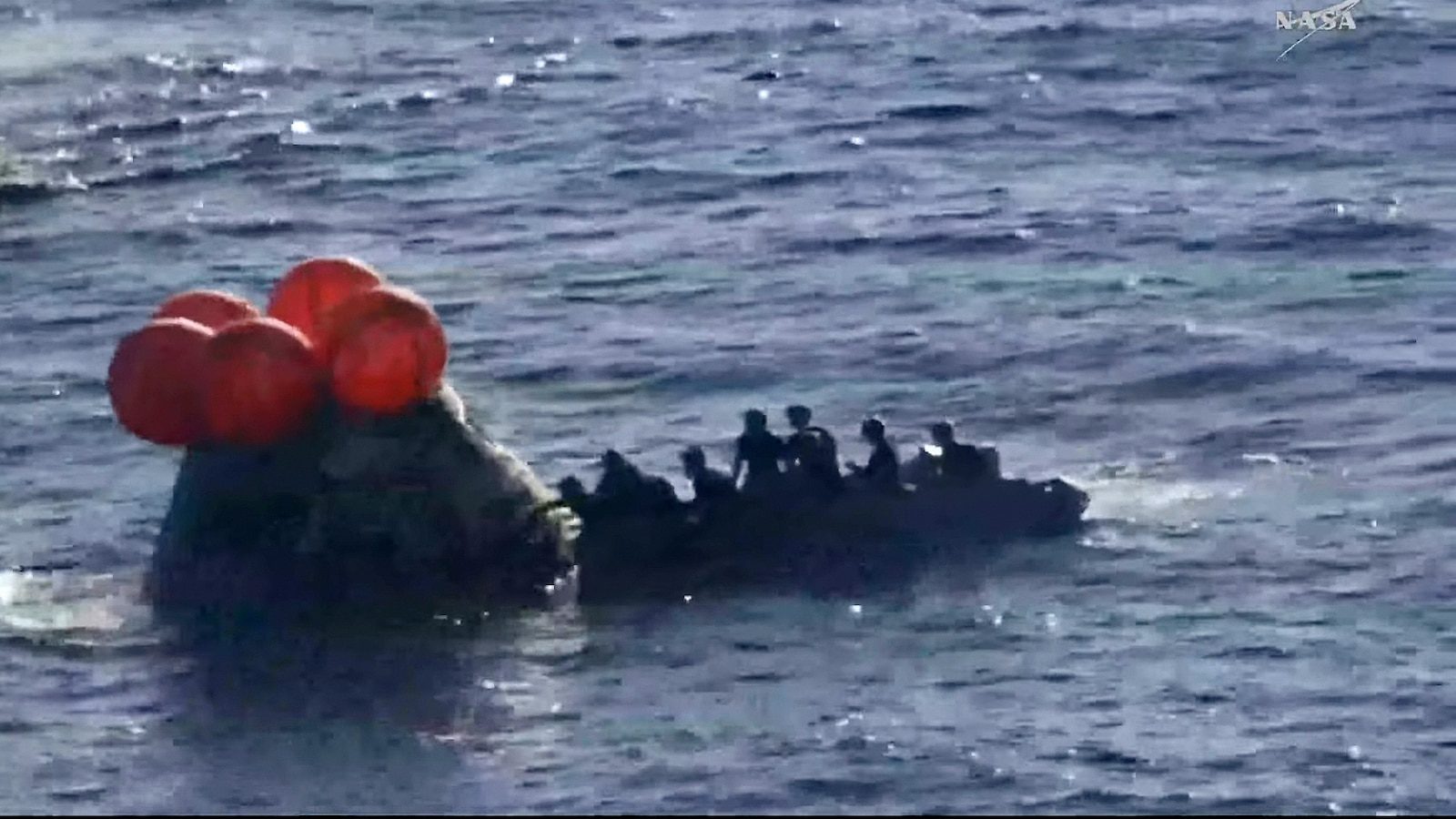
On April 11, 2026, at 00:07:47 UTC, NASA’s Orion spacecraft “Integrity” (CM-003) splashed down in the Pacific Ocean southwest of San Diego, completing humanity’s first crewed lunar mission in over 53 years — since Apollo 17 in December 1972. The crew was recovered by the USS John P. Murtha.
The mission launched on April 1, 2026, at 22:35:12 UTC from Kennedy Space Center Launch Complex 39B aboard the Space Launch System (SLS) Block 1 rocket, powered by four RS-25 main engines. The total mission lasted 9 days, 1 hour, 32 minutes, and 35 seconds, covering a staggering 694,481 miles (1,117,659 km).
Mission Timeline
- Day 1: High Earth orbit insertion, life support system verification checks
- Day 2: Trans-Lunar Injection (TLI) burn — a critical 5 minute 49 second engine firing that propelled Orion towards the Moon
- Day 6: Lunar flyby at just 4,067 miles from the Moon’s far-side surface; 40-minute signal loss as the spacecraft passed behind the Moon
- Day 6: Crew captured a solar eclipse lasting 57 minutes — the Moon blocking the Sun as seen from Orion
- Days 7-10: Return trajectory with three correction burns for precise splashdown targeting
- Re-entry: Orion entered Earth’s atmosphere at approximately 34,965 feet/second (Mach 32), with its heat shield enduring temperatures of about 2,760 degrees Celsius
The Crew: Four Astronauts, Four Historic Firsts
Artemis II carried four astronauts — the most people ever in deep space simultaneously, surpassing the three-member crews of all Apollo missions. Each crew member made history:
- Reid Wiseman (Commander, NASA) — became the oldest person to travel beyond low Earth orbit
- Victor Glover (Pilot, NASA) — became the first person of color in deep space beyond LEO
- Christina Koch (Mission Specialist 1, NASA) — became the first woman to travel beyond low Earth orbit
- Jeremy Hansen (Mission Specialist 2, Canadian Space Agency) — became the first non-US citizen to travel beyond low Earth orbit
The diversity of this crew is significant from a social justice and equity perspective — a topic frequently tested in CLAT. After decades of space exploration dominated by a narrow demographic, Artemis II demonstrated that deep space is becoming accessible to a broader representation of humanity.
Records Broken: Apollo vs Artemis
- Distance record: Artemis II reached 252,756 miles (406,771 km) from Earth, surpassing Apollo 13’s record of 248,655 miles set in April 1970
- Most people in deep space: 4 astronauts simultaneously vs Apollo-era missions with 3 crew members
- First crewed lunar mission in 53+ years: The last was Apollo 17 (December 1972)
- First woman beyond LEO: Christina Koch broke a barrier that stood for 65 years since the dawn of human spaceflight
- First person of color beyond LEO: Victor Glover’s achievement came 57 years after the Outer Space Treaty declared space the “province of all mankind”
Technical Highlights
The Orion spacecraft used a European Service Module (ESM) with an AJ10 main engine, showcasing international cooperation in space hardware. During the flight, a helium leak was detected in the ESM, though it did not affect mission safety. The heat shield design was modified from Artemis I following concerns about AVCOAT erosion observed during the uncrewed test flight. Data from Artemis II will inform further modifications for Artemis III, which will attempt an actual lunar surface landing using SpaceX Starship as the lunar lander.
1. Outer Space Treaty 1967 (Treaty on Principles)
• Often called the “Magna Carta of Space Law” — 115 parties including India, US, Russia, China
• No national sovereignty in outer space (Art. II) — space is the “province of all mankind”
• Peaceful purposes only — no nuclear weapons or WMDs in orbit (Art. IV)
• State responsibility for national space activities, including private entities (Art. VI)
• International liability for damage caused by space objects (Art. VII)
• Astronauts are “envoys of mankind” entitled to rescue and return (Art. V)
2. Rescue Agreement 1968
• Elaborates Art. V of OST — obligation to rescue astronauts in distress
• Return astronauts to the launching State “promptly”
• Notify the UN Secretary-General and the launching authority
3. Liability Convention 1972
• Absolute liability for damage on Earth’s surface or to aircraft in flight
• Fault-based liability for damage in outer space
• Invoked once: Cosmos 954 case (1978) — Soviet satellite crashed in Canada, Canada claimed $6 million, settled for $3 million
4. Registration Convention 1976
• Launching States must register space objects with the UN Secretary-General
• Registry maintained by UNOOSA (UN Office for Outer Space Affairs)
• Enables identification and jurisdiction over space objects
5. Moon Agreement 1979
• Declares Moon and its resources the “common heritage of mankind” (Art. 11)
• NOT ratified by major spacefaring nations (US, Russia, China, India)
• Only 18 parties — considered the least successful of the five treaties
• Tension with the Artemis Accords (2020), which allow resource extraction
India’s Space Programme: Where We Stand
While NASA celebrates Artemis II, India’s own space ambitions continue to advance rapidly under ISRO (Indian Space Research Organisation):
- Chandrayaan-3 (August 2023): India became the 4th country to soft-land on the Moon and the first to land near the lunar south pole — a region of immense scientific interest for water-ice deposits
- Gaganyaan (upcoming): India’s first crewed space mission — will send Indian astronauts (Gaganauts) to low Earth orbit. If successful, India will become the 4th country to independently send humans to space (after Russia, US, China)
- Aditya-L1 (2023): India’s first solar observation mission, positioned at the Sun-Earth Lagrange point L1
- ISRO’s budget: Approximately $1.9 billion — a fraction of NASA’s $25+ billion — yet delivering world-class results
Key comparison for CLAT: While Artemis II was a lunar flyby (no landing), India’s Chandrayaan-3 actually landed on the Moon. Both missions represent different approaches — NASA focuses on crewed deep space exploration while ISRO excels at cost-effective robotic missions.
Canadian Space Agency & International Cooperation
Jeremy Hansen’s presence on Artemis II reflects the 2020 US-Canada space cooperation treaty through which the Canadian Space Agency (CSA) contributes the Canadarm3 robotic arm to the planned Lunar Gateway space station. In exchange, Canada secured astronaut seats on Artemis missions.
This model of international cooperation connects to several CLAT-relevant concepts:
- Article 51 of the Indian Constitution (DPSP): Directs the State to promote international peace and security and foster respect for international law and treaty obligations
- Article 253: Empowers Parliament to legislate on any subject for implementing international treaties, even if the subject falls in the State List
- Artemis Accords (2020): A US-led framework signed by 50+ nations (India signed in 2023) establishing principles for cooperative lunar exploration — including resource utilization rights, which some argue conflicts with the Moon Agreement’s “common heritage” principle
• GK Section: Expect direct factual questions — “Who was the first woman beyond LEO?”, “What treaty governs outer space?”, “When was the last crewed Moon mission before Artemis II?”
• Legal Reasoning: Passage-based questions on the Outer Space Treaty principles — sovereignty, liability, peaceful use. The Cosmos 954 case (Liability Convention) is a classic exam scenario
• Article 51 DPSP: Frequently tested — connects India’s treaty obligations to space cooperation
• Article 51A(h): Fundamental Duty to develop “scientific temper, humanism and spirit of inquiry” — directly relevant to space exploration
• Diversity & Social Justice: Questions on representation — why crew diversity matters, how it connects to equality under Art. 14-16
• India comparison: Expect comparative questions — Chandrayaan-3 vs Artemis, ISRO vs NASA, Gaganyaan timeline
| Launch Date | April 1, 2026, 22:35:12 UTC |
| Splashdown | April 11, 2026, 00:07:47 UTC |
| Duration | 9 days, 1 hour, 32 minutes, 35 seconds |
| Distance | 694,481 miles (1,117,659 km) |
| Max Distance from Earth | 252,756 miles (record — beat Apollo 13) |
| Spacecraft | Orion CM-003 “Integrity” |
| Launch Vehicle | SLS Block 1 (4x RS-25 engines) |
| Launch Site | Kennedy Space Center, LC-39B |
| Splashdown Location | Pacific Ocean, SW of San Diego |
| Recovery Ship | USS John P. Murtha |
| Lunar Closest Approach | 4,067 miles (far side) |
| Re-entry Speed | ~34,965 ft/s (Mach 32) |
| Heat Shield Temp | ~2,760 degrees Celsius |
O — Outer Space Treaty (1967) — No sovereignty, peaceful use, state responsibility
R — Rescue Agreement (1968) — Astronauts must be rescued and returned promptly
B — B(Li)ability Convention (1972) — Absolute liability on Earth, fault-based in space
I — I(Re)gistration Convention (1976) — Register all space objects with UN/UNOOSA
T — Treaty on the Moon (1979) — Common heritage of mankind, NOT ratified by major powers
Remember: “ORBIT” — just like what Artemis II did around the Moon!
What Comes Next: Artemis III and Beyond
Artemis III will be the next major milestone — attempting an actual lunar surface landing for the first time since 1972. Key details:
- SpaceX Starship will serve as the lunar lander — the first commercial vehicle to land humans on another world
- Heat shield redesign based on Artemis II data addressing AVCOAT erosion concerns
- The Lunar Gateway space station (with Canada’s Canadarm3) will eventually serve as a staging post for Moon missions
- Long-term goal: sustainable lunar presence as a stepping stone to Mars
Source: NASA Artemis Blog, ABC News, CNN — April 2026
Practice Quiz
Test your understanding with these 10 MCQs:
Practice Quiz — 10 CLAT-Style Questions
Click an option to reveal the answer and explanation.