

CURRENT AFFAIRS | 11 APRIL 2026
CLAT GK + SCIENCE & TECHNOLOGY
Humanity Returns to the Moon After Half a Century
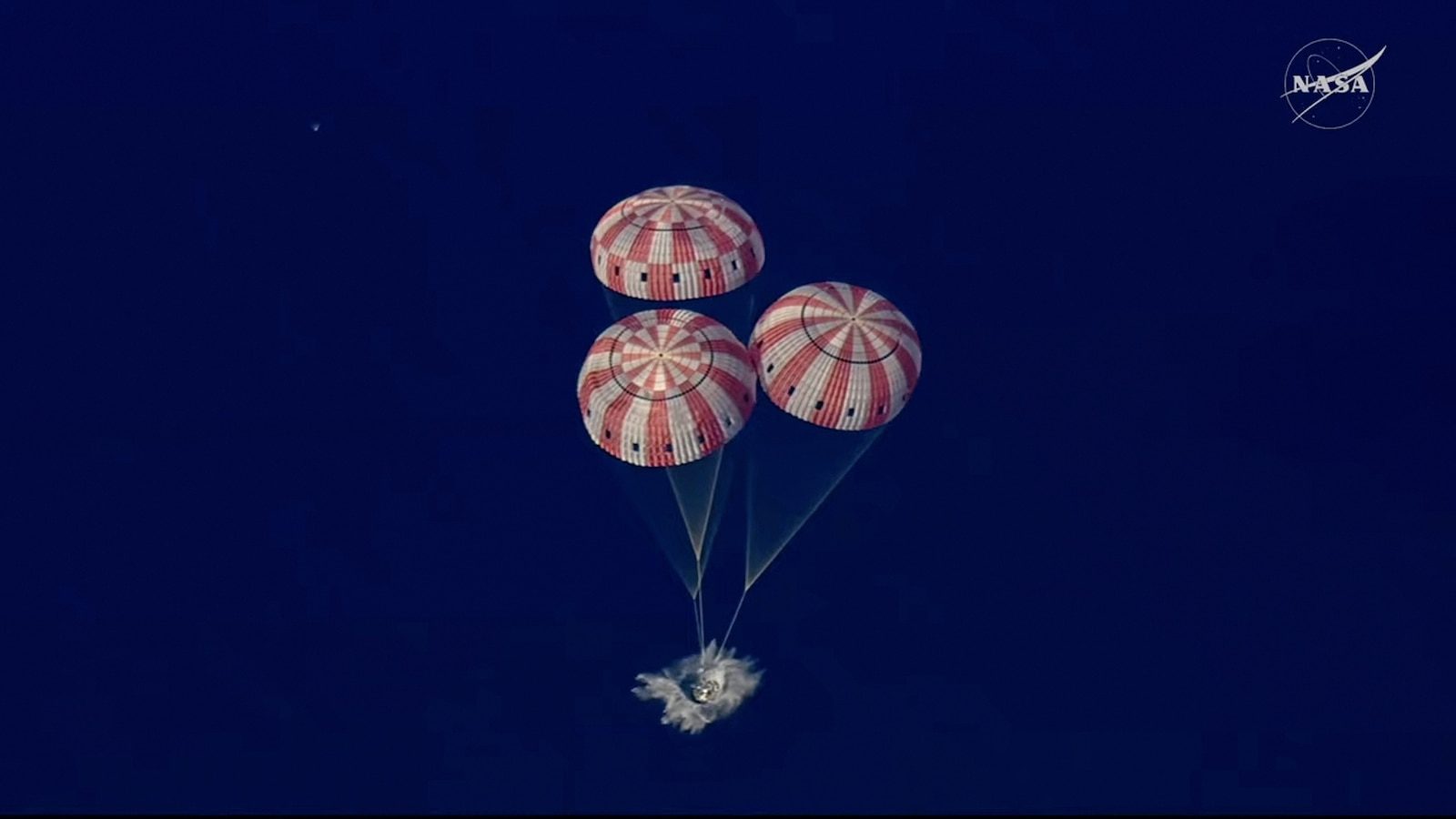
In one of the most significant achievements in space exploration history, NASA’s Artemis II astronauts splashed down safely in the Pacific Ocean off the coast of San Diego on April 10, 2026, completing a historic 10-day, 685,000-mile journey around the Moon and back. This was the first crewed mission beyond low Earth orbit since Apollo 17 in December 1972 — a gap of more than 53 years.
The Orion spacecraft re-entered Earth’s atmosphere at 32 times the speed of sound, with its heat shield enduring temperatures of approximately 2,760 degrees Celsius — about half the temperature of the Sun’s surface. Slowing to just 20 mph, Orion splashed down at 8:07 PM ET, where recovery teams from the USS John P. Murtha extracted the crew within two hours.
The Artemis II Crew
The four-person crew made history in multiple ways:
- Reid Wiseman (Commander, NASA) — Led the mission
- Victor Glover (Pilot, NASA) — First person of African descent to fly beyond low Earth orbit
- Christina Koch (Mission Specialist, NASA) — First woman to fly beyond low Earth orbit
- Jeremy Hansen (Mission Specialist, CSA) — First non-American to fly a lunar mission; representing the Canadian Space Agency
What Comes Next: Artemis III and the Lunar Base
Artemis II sets the stage for Artemis III, which will land astronauts on the lunar surface — including the first woman and first person of colour to walk on the Moon. NASA’s long-term vision includes establishing a sustainable presence on the Moon through the Lunar Gateway space station and eventually using the Moon as a stepping stone for Mars missions.
India’s Space Programme: A Parallel Journey
India’s space achievements provide excellent context for CLAT aspirants. ISRO’s Chandrayaan-3 successfully landed on the lunar south pole on August 23, 2023, making India the fourth country to soft-land on the Moon and the first to land near the south pole. India’s upcoming Gaganyaan mission aims to send Indian astronauts (Gagannauts) to low Earth orbit, marking India’s entry into human spaceflight.
Constitutional & Legal Framework
- Outer Space Treaty (1967) — The foundational treaty of international space law. Prohibits placing nuclear weapons in space, declares space exploration shall benefit all countries, and establishes that no state can claim sovereignty over celestial bodies.
- Moon Agreement (1979) — Declares the Moon and its natural resources as the “common heritage of mankind.” Notable that major spacefaring nations (US, Russia, China, India) have NOT ratified it.
- Article 51A(h) — Fundamental Duty to develop the scientific temper, humanism and the spirit of inquiry and reform. Space achievements directly embody this constitutional aspiration.
- Article 48A & 51A(g) — Environmental protection provisions relevant to space debris and planetary protection policies.
CLAT Angle: Why This Matters for Your Exam
Space law is an increasingly important topic for CLAT. Key areas to prepare:
- Outer Space Treaty principles — non-appropriation, peaceful use, international cooperation (frequently tested in legal reasoning)
- India vs global comparison — Chandrayaan-3 vs Artemis II, ISRO’s cost-effective model
- Scientific temper as Fundamental Duty — Art 51A(h) is a favourite in polity MCQs
- Common heritage vs national sovereignty — Moon Agreement debate, similar to deep-sea mining under UNCLOS
- GK questions on crew details, mission names, and chronological order of Moon landings
Key Facts at a Glance
| Mission | Artemis II (10-day lunar flyby) |
| Launch Date | April 1, 2026 |
| Splashdown | April 10, 2026 (Pacific, off San Diego) |
| Distance | ~685,000 miles (694,481 miles) |
| Re-entry Speed | 32x speed of sound |
| Heat Shield Temp | ~2,760 degrees C |
| Crew Size | 4 (3 NASA + 1 CSA) |
| Last Crewed Lunar Mission | Apollo 17 (December 1972) |
| Next Mission | Artemis III (lunar surface landing) |
Mnemonic: LUNAR
L — Law of outer space (Outer Space Treaty 1967)
U — UN Moon Agreement (common heritage of mankind)
N — NASA Artemis II (4-crew, 10-day mission)
A — Article 51A(h) (scientific temper duty)
R — Re-entry at 32x speed of sound, 2,760 degrees C
Practice Quiz — 10 CLAT-Style Questions
Click an option to reveal the answer and explanation.