

CURRENT AFFAIRS | 2 MAY 2026
CLAT GK + CONSTITUTIONAL LAW & RELEVANT AREA
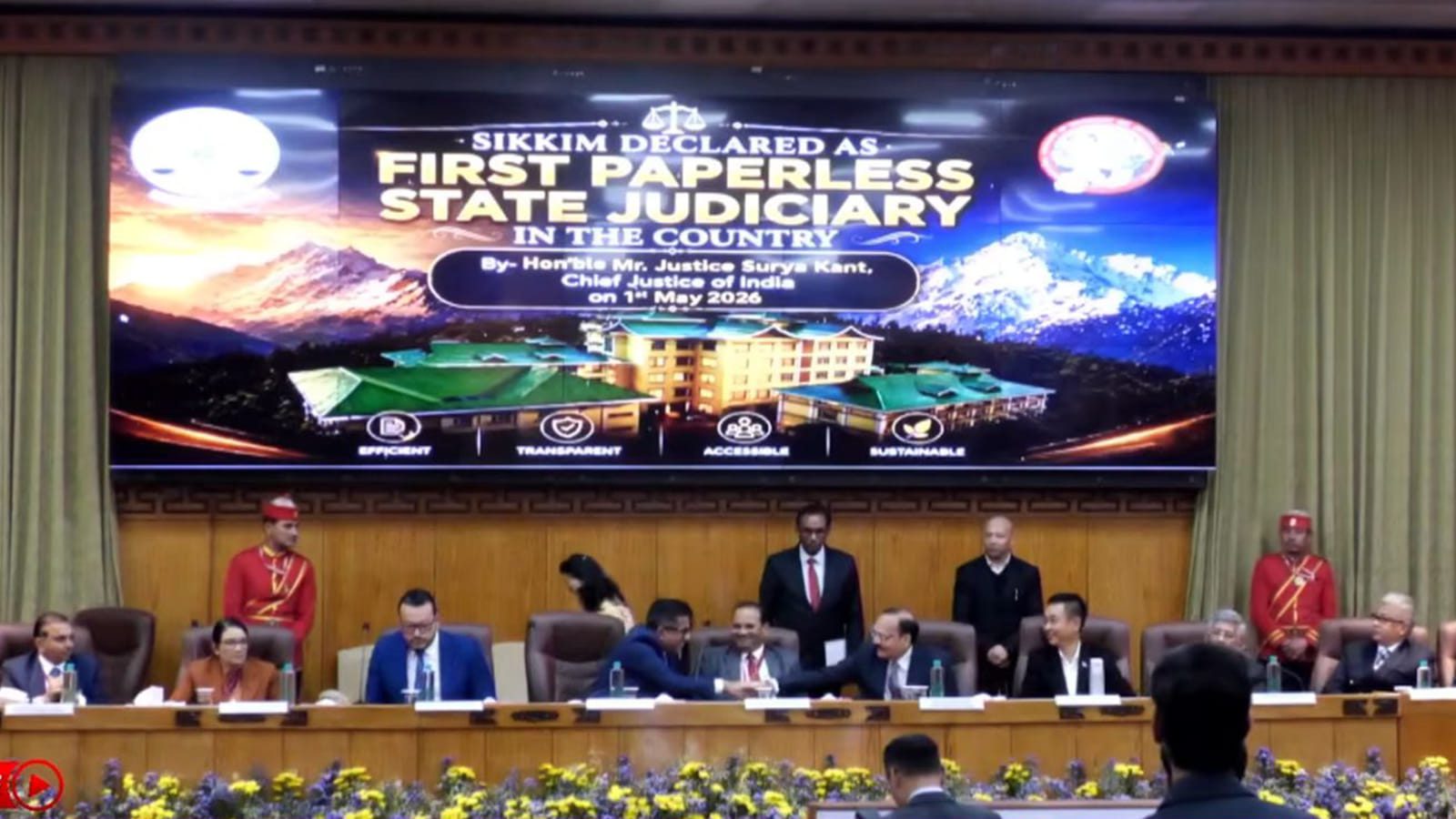
Inaugurating the two-day National Conclave on Technology and Judicial Education at Gangtok on May 1, 2026, Chief Justice of India Surya Kant announced that Sikkim has become the first state in India with a fully paperless judiciary. Calling digital reform “a practical necessity for sustaining the rule of law,” the CJI framed the e-Courts project as nothing less than a rewriting of the relationship between litigants and the law — records that “languished in physical storage” are now part of a “vibrant digital ecosystem” accessible from any browser, courtroom or mobile phone.
The constitutional weight of the announcement comes from Article 39A, the Directive Principle that promises free legal aid and equal justice. A paperless judiciary is the cleanest delivery mechanism for that promise: it slashes turnaround times for orders, lets prisoners and litigants inspect their files without travelling, and lifts the cost barrier that traditionally trapped poor litigants in cycles of pendency. Read with Article 14 (equality before law) and Article 21 (right to life and personal liberty, which courts have repeatedly read to include speedy justice), the Sikkim experiment is a test bed for whether technology can finally narrow the access-to-justice gap.
The financial backbone is e-Courts Phase III, a Rs 7,210 crore Cabinet-approved programme. Phase III moves beyond digitising records to building a unified case-management system, virtual courts, AI-assisted translation between Indian languages, and integrated portals for police, prisons, registrars and forensic labs. The Justice Madan Lokur Committee on judicial backlog and the Salem Bar Association v Union of India (2003) framework — which upheld the 2002 CPC amendments aimed at speedy disposal — together form the policy spine that the Phase III architecture is now operationalising.
Constitutional & Legal Framework
- Article 39A (Directive Principle): Free legal aid + equal justice — the constitutional anchor for digital courts.
- Article 14: Equality before law; access disparities are an Art. 14 violation.
- Article 21: Speedy justice is a part of right to life and personal liberty.
- Salem Bar Association v UoI (2003): Upheld CPC amendments for speedy disposal.
- e-Courts Phase III — Rs 7,210 crore, integrated case-management + virtual courts.
CLAT Angle — Why This Matters
- “First-in-India” milestones (Sikkim paperless, Ahmedabad first HAP) are GK exam-favourites — memorise the firsts.
- Article 39A is regularly contrasted with Articles 14 and 21 in legal reasoning passages on access to justice.
- Justice Madan Lokur Committee + Salem Bar Association = the standard “judicial reform” pair.
- Sikkim integrated into India in 1975 via the 36th Amendment — useful polity cross-link.
Key Facts at a Glance
| Element | Detail |
|---|---|
| Event | National Conclave on Technology and Judicial Education |
| Venue | Gangtok, Sikkim |
| CJI | Surya Kant |
| Milestone | India’s first fully paperless state judiciary |
| e-Courts Phase III | Rs 7,210 crore |
| Constitutional anchor | Article 39A |
Mnemonic
PAPER-LESS — Phase III of e-Courts, Article 39A, Pendency cut, E-filing, Rs 7,210 cr; Lokur Committee, Equal justice, Sikkim first, Salem Bar 2003.
Practice Quiz — 10 CLAT-Style Questions
Click an option to reveal the answer and explanation.






